UPDATE: Reviews section refreshed, redesigned, searchable: Go take a look
So, who honestly feels that this is a good [url= http://www.pinkbike.com/news/sram-announces-new-hub-standards-boost-148-and-110-2015.html ]idea[/url] and that it is trully needed? (and not another marketing gimmick)
I know it's been on the cards for a while now but it certainly sounds they are getting bored of popularizing a new wheelsize every couple of years, so I guess it was obvious the would move onto new hub standards! 😐
[img]  [/img]
So hang on - everyone is told they need bigger wheels - just cos - so everyone buys new bikes with bigger wheels. Now we are told that because our wheels are bigger we need wider hubs to make the wheels as strong as they used to be.... and you guessed it - another bike.
It may be correct that adding a few hub MM here and there will give stiffer wheels in a lab test.
It may be correct that moving BBs a few MM here and there will give shorter chainstays or clearance with bigger tyres.
[img]  [/img]
TBH, it makes me very, very angry.
Ostensibly, Boost 148 and 110x15 exist to increase torsional stiffness without additional weight penalty.
However, in the case of Boost 148 we're talking about marginal gains, especially when you consider that manufacturers seem to be moving towards 1x11 gearing and are no longer constrained to having to accommodate a front mech in amongst the main pivot hardware. What it will mean is that hubs we've all used for years are now no longer compatible with new frames and that it becomes a minefield for anyone upgrading.
110x15 however has me gnashing my teeth in a rage. We already have a great standard here, it's 110x20 and it's been around for years and does a fantastic job. All forks should be 110x20 and left as is, however for reasons best known to Shimano and Fox, they foisted 100x15 on us with the flimsiest of engineering common sense as justification. 110x15 stands for what, exactly? I don't want the bike industry to force another front hub standard on me, but I do want it to come up with a longer lasting BB interface.
Now that forks are going to have to be designed, engineered and manufactured for three different wheel sizes and three different axle standards it can only mean higher manufacturing costs which will be passed on to us consumers.
It's got to the point now where I intend to exercise my discretion as a consumer and boycott the entire production lines from manufacturers who persist in forcing unwanted and unnecessary standards on us and making us pick up the tab.
If it's all marketing, it's not working. It makes me want to hold onto my existing bike rather than replace it and risk blowing cash on a "standard" that will soon be replaced.
PJM1974 - Member110x15 however has me gnashing my teeth in a rage. We already have a great standard here, it's 110x20 and it's been around for years and does a fantastic job. All forks should be 110x20 and left as is, however for reasons best known to Shimano and Fox, they foisted 100x15 on us with the flimsiest of engineering common sense as justification.
Exactly this. I remember an MBR group test which said about 5 times "lightweight QR15" "The QR15 is lighter" then showed a picture of the axles on scales showing that the QR15 was a fair bit heavier than the maxle lite. I don't know whether they believed it was true through incompetence, or were peddling bullshit intentionally... But either way it's exactly the thought process that led to 15mm winning the standard war.
And now Fox know that they can do anything they like- they can sell a heavier part as light, they can sell a weak part as strong, they can even admit that the weak part isn't strong enough for their big forks, and nobody will bat an eyelid, and customer opinion doesn't really matter anyway as long as the OEMs are satisfied.
I find this pretty annoying too. Very marginal indeed, ostensibly for an even more niche + size of wheels. I guess the front hub was vulnerable to more fiddling at mass market level, being 'stuck' at 100mm (in most cases) for so long. It multiplies the combinations of axle size/hub width yet further...
Its always appeared to me that the reason QR15 is significantly less stiff than QR20 is less to do with the diameter of the axle and more to do with the fact that it isn't pinch tightened at both ends like to 20mm axles are, instead it just screws in.
Surely if you had the same clamping design you get on Fox 36 forks with a normal 15mm axle then you would not be far off the stiffness of a 20mm axle.
This is actually the reason I discounted a trek as my new bike as I have some great carbon 29er wheels and wouldn't be able to use them. Oh, and I feel they would be way stiffer than any boost 148 alu ones!
[url= https://i.imgflip.com/j00b7.jp g" target="_blank">https://i.imgflip.com/j00b7.jp g"/> [/img][/url][url= https://imgflip.com/memegenerator ]via Imgflip Meme Maker[/url]
I blame the roadies for nicking our hub width standards and ousting us.... The blighters;)
I'll probably eventually just suck it up at the next changeover as with all these things that are foisted on us. Ho-hum!!
I hate to have to say this, but I think we should all vote with our wallets.
We're in a situation where unnecessary standards are increasingly being used to design in product obsolescence. All it's succeeding in achieving is to massively overcomplicate the aftermarket options out there and raise production costs for manufacturers, which are in turn passed on to us.
Trouble is though that the buying power doesn't lie with individuals buying forks, it's with the big batallions... And not many people will let the axle or hub standard decide their bike, unless it's something really whacked out.
Well, I for one, won't be buying anything from trek despite being offered a significant discount on any one of them.
Anyone want some non-convertible 110x20 hubs/wheels? Seem to have lots of the now useless things kicking around. A great standard killed off deliberately. And now the standard that killed it will be killed off deliberately. How long before that one is killed off? 3 years…?
3 years…?
I would say more like 5, but I get your point. 🙄
Looking at my bikes, all are QR front and rear, with 2 of them still running rim brakes. I'm also building my next frame QR front and rear, the bike industry must really love me!
kelvin - MemberAnyone want some non-convertible 110x20 hubs/wheels?
I converted some of mine to 15mm with the universal adaptor
[img]  [/img]
Not always possible mind but you can often shorten and sleeve or tophat them.
universal adaptor
I will be using that phrase in the future if you don't mind 😀
It is strange that everything got oversized and stiffer but they went down from 20mm front axles to 15mm. Thought they would have brought in a 22.5 standard or something. I've upgraded my old flux now as much as I can really now. Bought a spare set of 1 1/8 in forks. Won't be buying anything else until I crack the frame (or see a burner or flux at a great price). When I read about 148mm a few months ago I wasn't sure if it was a joke or not.
It's about shifting us towards buying complete bikes, rather than doing the triggers broom thing. And it works.
I'm not so sure about that. Biking's had a resurgence, definitely UK and I think much wider but that means new riders buying a whole bike rather than the long-termers.It's about shifting us towards buying complete bikes,...And it works
There are long-termers who've always bought a new bike every couple of years, but then there's what I suspect is the majority who buy a bike for a longer stretch. A bit like Onza, I'm now deliberately NOT considering a new bike because of all this shit.
I'm definitely after a new bike. It'll be B+ though and I've had to delay buying until I see where all the standards are going. That's probably a 12 month delay from when I started thinking about it.
29/B+ is the category that will actually benefit from this. Wider chain line gives greater drivetrain options while maintaining tyre clearance.
20mm axles dead? Seen any DH bikes with anything other than 20x110mm?
15x100mm was more about denoting what kind of riding the fork/bike was aimed at. Shame it wasn't 110 from the get go.
142 didn't kill off 135, so hopefully 148 won't kill off either, and simply be used where appropriate (trail 29ers and 29/B+).
20mm axles dead? Seen any DH bikes with anything other than 20x110mm?15x100mm was more about denoting what kind of riding the fork/bike was aimed at. Shame it wasn't 110 from the get go.
Indeed, but 20mm was entirely suitable for all bikes… why have x standards when you could have 1? From the riders point of view that is.
142 didn't kill off 135, so hopefully 148 won't kill off either, and simply be used where appropriate (trail 29ers and 29/B+).
But 142/135 are really just the same hubs, with different end caps. This is something else… but no, I don't see it killing off 142… not entirely convinced it's be that widespread. Who knows…?
148 boost will be dead in 5 years, much like Giants Overdrive 2.
Not so sure about 15x110 axle spacing though as Sram will just make sure every manufacturer specs them.
sillyoldman - Member20mm axles dead? Seen any DH bikes with anything other than 20x110mm?
That's a big part of the stupidity- we should have 2 axle standard for all quality bikes, 20mm or QR, but instead we [i]still[/i] have 3, it's an amazing combination of restricting customer choice to an inferior product, while still having all the drawbacks of multiple standards.
Damn, so my new Pikes are crap already and I haven't even scratched them yet.
That's a big part of the stupidity- we should have 2 axle standard for all quality bikes, 20mm or QR, but instead we still have 3, it's an amazing combination of restricting customer choice to an inferior product, while still having all the drawbacks of multiple standards.
Don't forget 12x100 that's coming for road bikes.
The right approach to all this seems to be:
- buy a new bike;
- sell your old bike;
- don't read any bike magazines for 5 years;
- repeat.
🙂
surely without changes in standards, we would still all be riding stuff like this
[img] 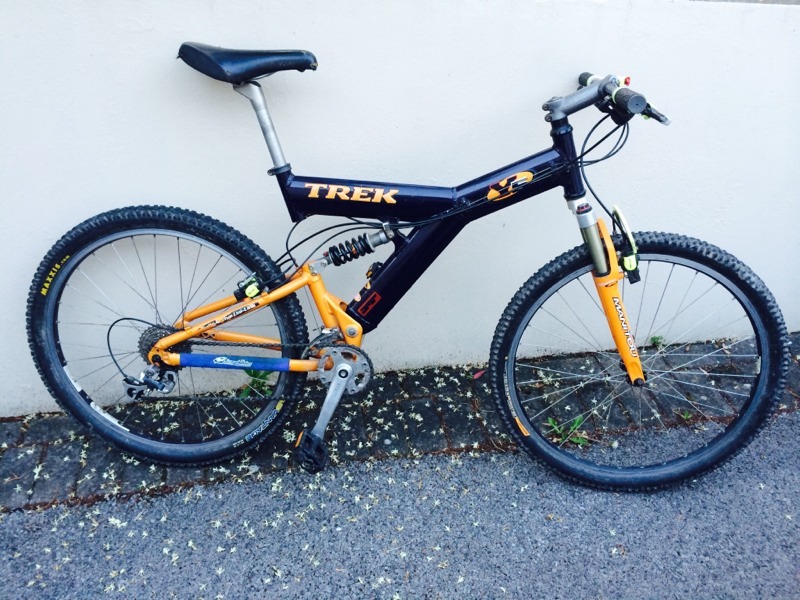 [/img]
Well, that has:
- hubs;
- wheel size;
- BB thread and width; and
- headset diameter and interface;
that remained reasonably standard for quite a few years. Things improved/changed a lot before most of what's on that bike because completely obsolete. Disc brakes did for the frame, forks and wheels of course...
Does 20x110 have wider brake and flange spacing than 15x110? No. The wider flange stance is what the new size is about, to create stronger larger wheels. For folk like me that's good news via we find 29er wheels flexy.
al - MemberDoes 20x110 have wider brake and flange spacing than 15x110? No.
There's absolutely no reason why it couldn't, though- the reason 20mm uses a narrow hub and wide spacers was to preserve compatibility with older designs (what a concept!), the potential is still there. And 20x110+ would give much stronger compatability- you could forward-compatible wheels with a brake disc spacer, backwards-compatible forks with an offset brake spacer (the difference in hub width is barely less than a PM spacer can accomodate at its extremes). You wouldn't get the flange width change but it remains to be seen if that's going to deliver on promises (or whether it'll end up like 150mm wheels and generally be bullshit)
Well, I for one, won't be buying anything from trek despite being offered a significant discount on any one of them.
^this. I certainly won't be buying anything Trek. As consumers we can hit those in the OEM market by not buying their complete bikes. The industry is trying to control the market with punitive measures against the likes of you and I so that we buy complete bikes more often instead of enabling us to upgrade what we already have. This approach is fine if you're buying a £35 iPod every couple of years, but it's not bloody on when you're spending upwards of £2k every three years. I don't like it and I don't believe that anyone else should put up with it either.
surely without changes in standards, we would still all be riding stuff like this
Apples and oranges. I've no issues with new standards where they make sense - the 1.5" headtube and 20x110mm are great examples. Both came before the new defacto standards that replaced them and are lighter, stiffer to boot. Tapered head tubes and 100x15mm made no sense because they were inferior to what was already out there and existed simply for marketing purposes.
Again, 135x12 and 142x12 are also good examples of new standards that work for most people - it's win-win because the consumer gained a stiffer axle interface that was backwards compatible with many aftermarket hubs.
Post mount beats IS mount because it's easier for manufacturers to cater for different rotor sizes and those stuck with the old standard can use adaptors. Again, win-win. This is probably the last standard I can think of that was developed with convenience for the consumer in mind.
Boost 148 offers marginal gain, for the cost of new hubs and cranks. It's business practice at it's most cynical and I'm terribly upset about it.
the whole issue could have been avoided if they carried on using the existing hub/axle standards and just used bigger diameter hub flanges on 29in wheels to give stronger wheels but that wouldn't have been too easy wouldn't it....the answer is
don't buy bikes from trek/giant/spesh
maintain your current bike
only buy a bike that has widely supported standards built into it
From what I can see, Spesh aren't forcing new standards yet...their PF30 system can simply be adapted to fit existing Shimano axles and/or threaded BB systems.
The 142+ rear axle I have on my Stumpy works with my existing Hope Evo hubs and some adaptors that cost me £12 so I'm reasonably happy here.
To be fair to specialized they've generally tried to make their own funky standards somewhat intercompatible- my Roval wheels are 25mm fork compatible frinstance and 142+ is straightforward to make compatible parts for, their QR+ thing was entierly about compatability... Doesn't mean every wheel company will do it of course but if your wheel has a 12mm axle it [i]could[/i] be converted in principle.
Whereas this one almost seems to have been designed to minimise compatability.
Ok, now I'm seriously confused. (screenshot from boost article on STW)
[img] 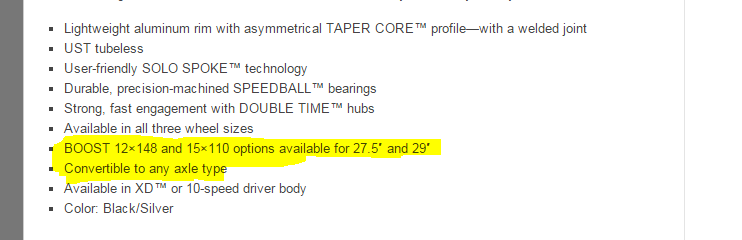 [/img]
To me this suggests that the new Boost hubs will be able to be converted back to 142,135,qr ect, so therefore making it impossible for the flanges to be further out or that they could have been move out with a 142mm hub
It's either that or a misprint/misinterpretation.
To me this suggests that the new Boost hubs will be able to be converted back to 142,135,qr ect,It's either that or a misprint/misinterpretation.
Its a misinterpretation, the roam 40 wheels and hubs are available in normal sizes, and now in 110/148 format. Its confusing as the article is about boost, but the sram tech specs are for the wheels in general.
It's a bit of a piss take but inevitable I guess now that 15mm and 142/12mm seems to have been accepted by most.
142 axles weren't too much of an issue because a lot of hubs are convertible. They do seem to provide some added stiffness which is good on longer travel bikes.
The 15mm axle standard is a joke and seemed like Fox trying to be different for the sake of it (easy to do with the backing of Shimano who have never pushed od things....). I have a 15mm axle on one bike and I don't think that it is as stiff because I get more rotor buzz in corners than I do with my Devilles (same size stanchion but 20mm axle).
I guess headtubes will need to be revisited now that tapered steerers have been accepted by most!
It does wind me up a bit because the bike industry seems obsessed with extracting as much money out of riders as possible with planned obselence. I know they need to make money to survive and grow but the way they are doing it is unlikely to be sustainable. I think the issue that they are facing is that bikes are so good now, there's not much room for improvement left.
Side point, what deos 'torque compatible' in the new Boost Rockshox forks mean?
I could accept 15mm as the replacement for QR, compared to QR on a fork with tabs it's arguably quicker to fit, more solid connection, less chance of wheel being ejected and most hubs are convertable with end caps/axles.
15x110 can bugger off tho, there is already a big bike standard, 20mm, no need to invent a new one and WTF have sram gone along with it? They already had maxle lite.
daftness.
The trigger's broom approach to keeping a bike long term only really makes sense if the parts you're replacing are crap though. It used to be that you would buy a bike for the quality of the frame, and perhaps put up with less than top drawer components, replacing them as they wore out. Increasingly now you can buy a bike that you'd be hard pushed to "need" to replace anything on, as the quality of componentry has got better. Who would choose to replace their 2015 SLX rear mech with a 1995 XTR one? very few I'd suspect
whereas I'm not a fan of marketing lead "improvements" I'm happier to buy a complete bike, that doesn't necessarily need 3rd party "improved" parts to make it perform adequately, and hence I'd be less worried about move away from the need for standards.
Surely just more reasons to only buy hubs that are easily converted to the many standards - Hope's?
HT is either 15mm and 20mm front (20mm 36's, 15mm Revs and 20mm Reba's) with 9mm QR rear.
FS is on 15mm front (15mm 32's and Pikes) with a 142x12 rear.
And 5 sets of Hope hubbed wheels.
I may be missing something but given that 110 > 100 won't it be possible to just fit different (wider) end caps to something like a hope hub and it'll still fit in the fork? Granted you won't get the apparent benefit of the wider flanges but it should still fit?
What am I missing?

