In the grand tradition of British folk in sheds making amazing things, we have a word with the bloke behind the best-looking bikes of Bespoked.
Words & pictures: Benji
During my visit to the Bespoked Hand Built Bicycle Show this year, amidst all the steel full suspension and the steel drop bar, gravel-ish, all-road bikes, two bicycles stood out head and shoulders above everything else. Both were on the Medusa Cycles stand. One was a 29+ touring bike called the Kangal. The other was a 27.5 town bike called the Brassica. The person behind them was, er… behind them. His name was Pete Skelton.
After the Bespoked show – where Medusa Cycles won a couple of awards – I visited Pete in his back garden shed to hear a bit more about his journey.
What was the first bike or frame you built?
Well, it was a frame. When I first decided I wanted to do it, I was thinking about… I didn’t know where you would get tubes or anything like that and I was like maybe I could chop up an old frame. I found a Peugeot Premiere frame, old knackered thing that was just like good for nothing, other than chucking the scrap. So I chopped it up, sanded the paint off the tubes and mitered the tubes to build a frame which I’d drawn. I had a book from the ’70s that my Dad gave me. Anyway, I must have got something wrong because after I brazed it all together in my Dad’s garage, it was just completely wrong. The cranks were about five millimetres off the ground in the end. Luckily, I hadn’t painted it or anything, I just sort of chucked it together and thought, ‘Oh, that’s not right.’ Ah. Right, OK… I’ve still got that frame somewhere at my Mum and Dad’s. It’s rusting away now. That was my first attempt at building any kind of bike frame-related thing.
What was it intended to be?
I wanted it to be a bit of an old road sort of thing purely because I had a fork already. I was working at Ribble at the time and I’d just got like a write-off fork. I had to keep it secret from my Mum because my Dad was like, ‘Oh, don’t tell your Mum because acetylene in the garage… if she knew what that was, she wouldn’t be best pleased. It’s quite volatile.’
What was the first successful build then? It must have been for yourself.
Yeah, it was. I did a bit of an apprenticeship-type thing at Butterfield Bicycles in North Manchester. I wanted to have a go at making something for myself. It was like a bikepacking type, utilitarian, all-road, kind of monster-cross type of thing.
Before making the bike, you’d been on an epic ride, basically from Blackburn to India, is that correct?
Yeah. Before that bike trip I didn’t know what I wanted to do. Part of why I went was to sort of figure out what it was that I should do with my life. I’ve got no qualifications, what can I do? So I thought I’ll go and do a big overland trip on the bike to India. And while I was doing that I was like, well, I’ll try to start my own brand.
Can you remember the route you took to India?
I went across France and Italy. Went across the Alps to Italy and from there into the Balkans, down the coast. It’s called the Parenzana in Croatia, it’s an old Austro-Hungarian railway route that goes through Bosnia and into Croatia. Through Albania into Greece. Got a ferry from there to Turkey. Spent three months in Turkey. Turkey’s gigantic. A huge place and so varied. It was in the middle of winter as well, so it was absolutely freezing up there in these mountains. It was pretty testing, really. Across Georgia, Azerbaijan, across the Caspian Sea and into Kazakhstan, then did the Pamir Highway. I say we cycled to India, but we got as far as Kazakhstan and then flew to India because going through China wasn’t going to happen.
What bike did you take on that adventure?
It was a Surly Long Haul Trucker. A pretty robust thing, but there were parts of that bike that weren’t quite suited to doing weeks of washboard roads at 3,500, 4,000 metres above sea level. You’re just absolutely dying. Bikes are falling to pieces. At that point, I was like, ‘Why did I not choose to do this on a mid-fat type bike or something with at least like a 29er wheel?’
And that’s where the idea for the Medusa Kangal originated?
Yeah. There were parts of that Surly build that I liked. The 8-speed drivetrain and the triple chainset. Plenty of gear options, and it just seems to last forever. I had a Shimano UN55 bottom bracket in that thing that survived the trip, and I think it’s still on one of my other bikes now. That Long Haul Trucker was a rim brake bike, and the rims were just completely worn out by the time I got back. I was loaded up with at least 60 kilograms, you know, for four-season travel and not knowing what I was doing. I was carrying my entire life on the bike. So, if I were to do that trip again, it would definitely be on disc brakes. And a bigger wheel. I had also tried a rim dynamo, which was quite good. It would have been OK for just road riding, but it got clogged with mud.
Tell me about the nuts and bolts of designing the Kangal.
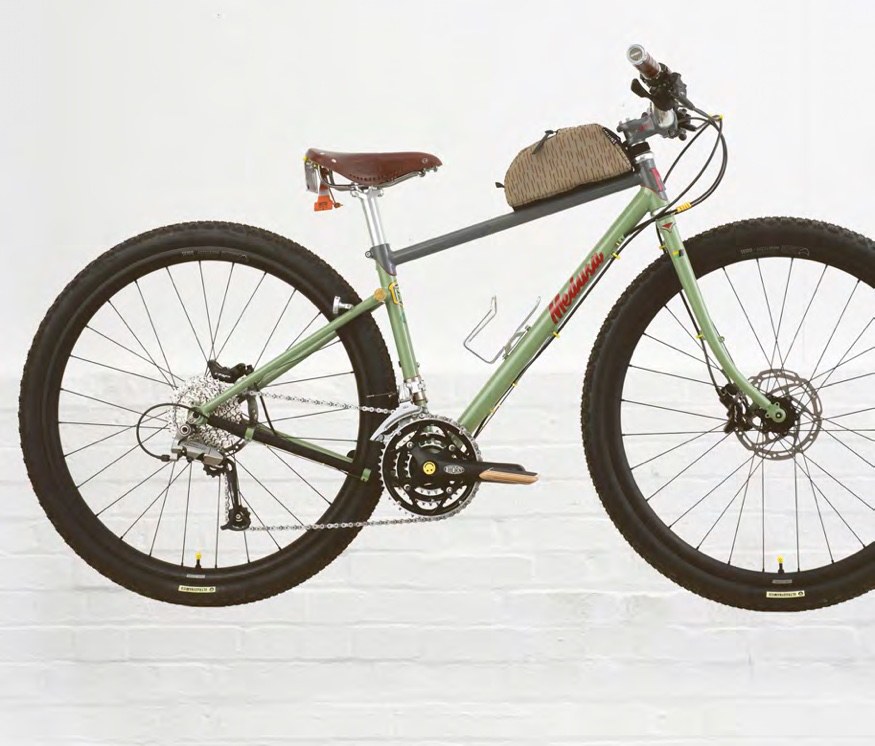
I’d done some half-elevated chainstay bikes in the past, but with this, I just thought, sod it, I’m going to do a double-elevated chainstay. I knew where it was going to be flexy, so I tried to reinforce it with certain bits. But a lot of that I just kind of did because I like the look of it and I knew it was going to give plenty of tyre clearance. Because of the length of the bike, I had to get Reynolds to custom draw me out a down tube. Because it’s got such a low bottom bracket drop, the distance from the BB to the bottom of the head tube is pretty big. I was going to bend it as well.
I imagine if you’re fully laden with luggage, there’s a lot to be said for a bit of give in a frame…
Yeah. That was one thing about my Long Haul Trucker; that thing was so flexy. You could put your foot down on it and the whole back end would twist. But I guess you want a bit of flex, don’t you?
One thing that I really like is that you also make your own forks.
Yeah, I think these days people want lightweight things and a steel fork is heavier. But I’d been making forks under my own name for the past year when I got a fork jig. And one thing on my India trip, a chap that I did part of the ride with had one of his pannier bosses rip off. In the middle of Tajikistan. And he got it welded back on. He couldn’t do that if it was carbon. So the practicality is definitely there with steel.
What about geometry? Do you have any magic numbers?
I like a steep seat tube, but that’s mainly just because I’ve had a bit of knee pain in the past and I find that if I’m a bit further over the BB that just limits the amount that my knee’s chopping up and down. So there’s a bit of that, but that’s not gospel really. One thing I do like is pretty much every bike I’ve built, they’ve all got the same trail value on the fork: 69mm. I just find it handles very nicely. Not too twitchy. It’s a fairly standard sort of touring bike rake designed for heavy loads.
For those of us who’ve not designed a frame, walk me through your process.
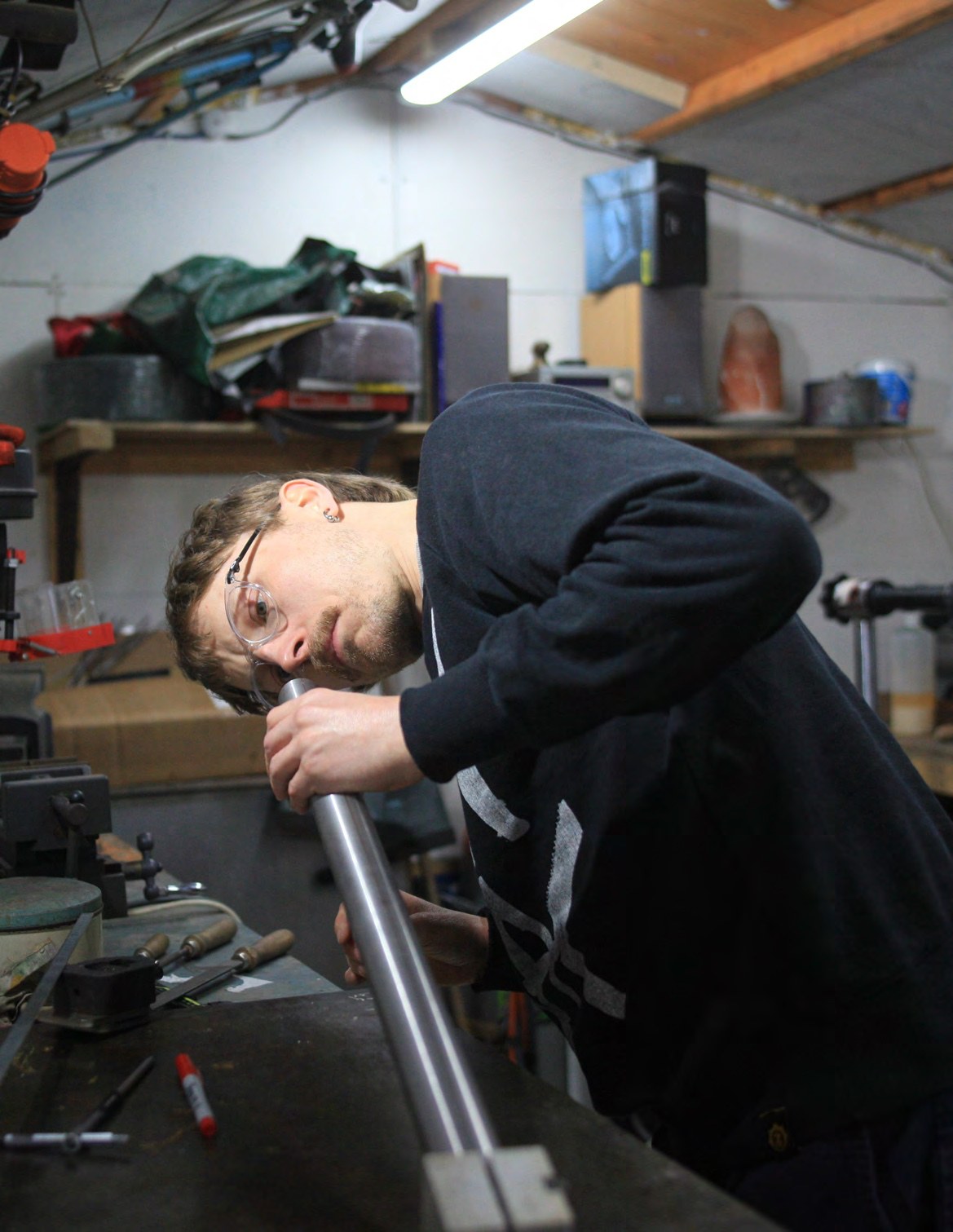
So I would draw something up for the customer. I would just adjust the standover accordingly. I will cross-reference the rider compartment of a bike that they’ve got already that they find very comfortable. And I’ll try to figure out a number according to that. From there, if I’ve got the drawing dialled in, I will cut all the tubes and make a start. I will order anything needed, like a funny length tube or whatever. The last one I did was made out of stainless steel for a customer. Getting all the stainless parts was a bit of a challenge. Especially with some of these tariffs that have been happening and the material shortages. So anyway, I get everything piled up so I know I’ve got everything there and I can just start cutting. I have these aluminium tube blocks – you’ll find on pretty much every steel bike frame, the tubing diameters are all a fairly standard diameter. I’ll put the blocks in my vice. I’ll either do the cutting with a file, especially if it’s something like stainless. I’ll miter it by hand. Once all the tubes are cut, I’ll clean everything up, make sure there’s no grease on there. It’s important to clean the inside of the tubes.
Do you put all the tubes together in the jig before starting welding?
It depends, really. Sometimes I will just do the downtube and the seat tube and I’ll braze the downtube to the bottom bracket and then I can get that set up in the jig. If there’s been any discrepancies between my drawings and things in the real world, I might have to do a little bit of messing around to get everything to fit properly. Then I tack it up and take it out of the jig and start brazing, to give it a little bit of room to move while you’re putting heat through it. As you start putting any kind of heat through bike tubing it wants to start bending and finding its own way, so you’ve got to kind of anticipate that. You’ve got to make sure you’re brazing it in even ways – you’ve got to braze one side of it and then do the other. You can’t just chase your way around the tube, otherwise it’ll just end up being like a corkscrew or something.
I’ve always wondered about getting hold of the bottom bracket shells with these sort of things…
There are people who make these themselves; maybe I will do at some point. But Reynolds make them. There’s a company in Derbyshire that makes them – Bear Frame Supplies.
What about the paint job? How much of it do you do personally?
Sometimes I will paint them myself. The last few, C&G Finishes in Liverpool, have done them. But yeah, I will do the lettering and paint other bits myself with a brush. I also lacquer with a brush. I worked as a traditional coach apprentice for a bit. I learned how to paint stuff with a brush and it does give a good finish. People think there are lots of brush strokes, but if you get the right paint, it flows out really well.
How long does it take to complete a frame build?
With the Kangal, I was really pushed for time with that, as I had to get it done for the Bespoked show. I managed to get that done in about two weeks. But that was running myself into the ground doing it. While working a full-time job.
What’s next for Medusa Cycles?
The one I’m making next is a Medusa Brassica. I’d like to be able to offer that one off-the-peg. I’d like to be able to make it a bit more affordable. I’ll also be moving workshops. I’ll be based in Ancoats, hopefully by sometime in summer. So if anybody wants to come and visit me and my new workshop, I’ll be there some days at Pollard Yard in Manchester.
medusa-cycles.com — @medusa.cycles


