From the Singletrack archive: this Through The Grinder section first appeared in Singletrack Magazine Issue 111 (2017). Words by the Singletrack Grinder team, photography by Rob. Prices and distributor details were correct at the time of publication.
We’ve had biblical rain, pea-souper fog, snow, freezing rain and occasionally, the bluest of blue sky days. Throughout all of this, the Grinder test team has been riding at all hours to bring you this issue’s collection of rubber and metal on test. Enjoy it while we go for a bit of a lie-down.
Bontrager Rhythm Shoes
Price: £139.00 | From: Trek Bikes | Tested: Three months | By: Wil
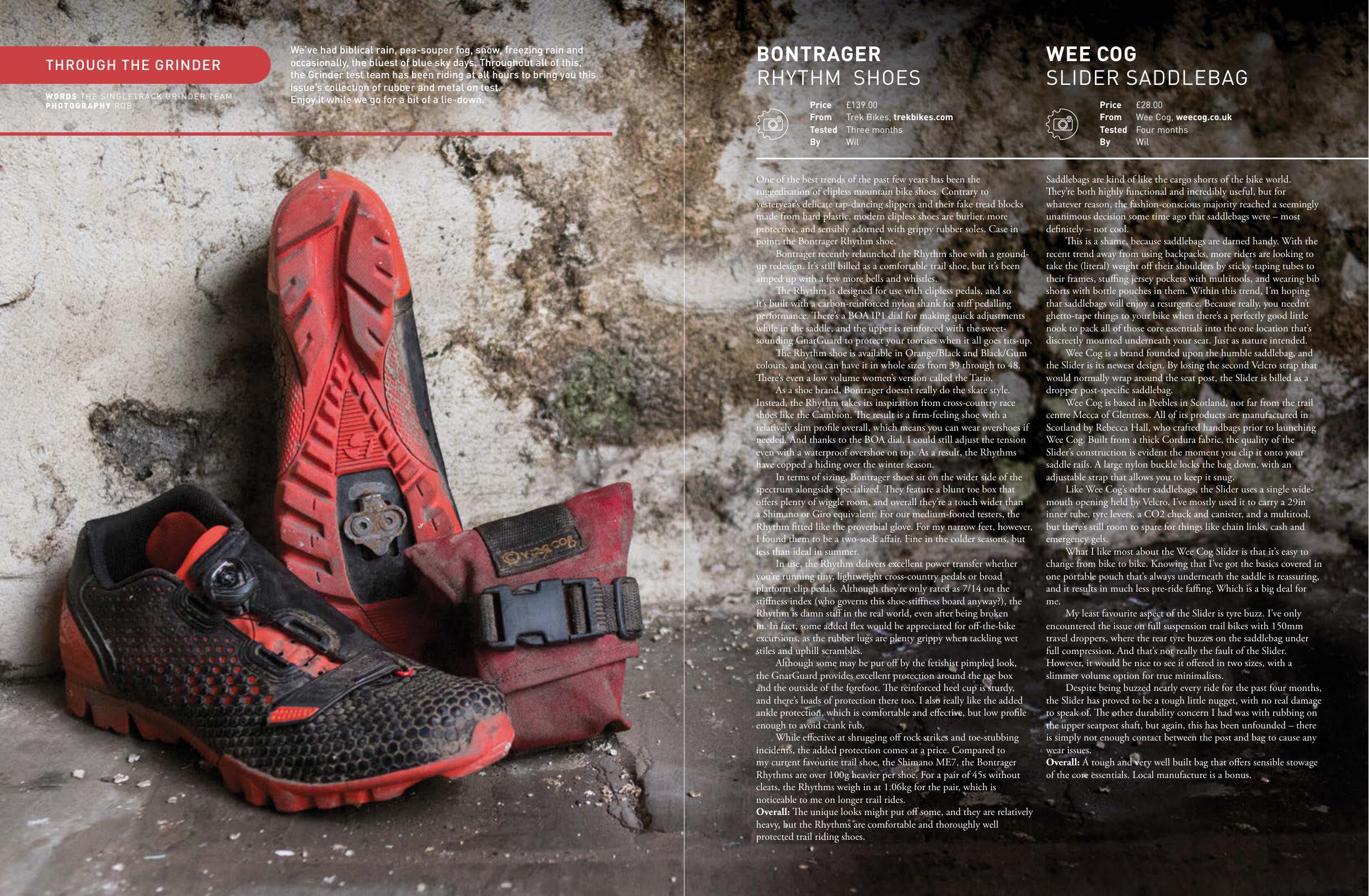
One of the best trends of the past few years has been the ruggedisation of clipless mountain bike shoes. Contrary to yesteryear’s delicate tap-dancing slippers and their fake tread blocks made from hard plastic, modern clipless shoes are burlier, more protective, and sensibly adorned with grippy rubber soles. Case in point; the Bontrager Rhythm shoe.
Bontrager recently relaunched the Rhythm shoe with a ground-up redesign. It’s still billed as a comfortable trail shoe, but it’s been amped up with a few more bells and whistles. The Rhythm is designed for use with clipless pedals, and so it’s built with a carbon-reinforced nylon shank for stiff pedalling performance. There’s a BOA IP1 dial for making quick adjustments while in the saddle, and the upper is reinforced with the sweet-sounding GnarGuard to protect your tootsies when it all goes tits-up. The Rhythm shoe is available in Orange/Black and Black/Gum colours, and you can have it in whole sizes from 39 through to 48. There’s even a low volume women’s version called the Tario.
As a shoe brand, Bontrager doesn’t really do the skate style. Instead, the Rhythm takes its inspiration from cross-country race shoes like the Cambion. The result is a firm-feeling shoe with a relatively slim profile overall, which means you can wear overshoes if needed. And thanks to the BOA dial, I could still adjust the tension even with a waterproof overshoe on top. As a result, the Rhythms have copped a hiding over the winter season.
In terms of sizing, Bontrager shoes sit on the wider side of the spectrum alongside Specialized. They feature a blunt toe box that offers plenty of wiggle room, and overall they’re a touch wider than a Shimano or Giro equivalent. For our medium-footed testers, the Rhythm fitted like the proverbial glove. For my narrow feet, however, I found them to be a two-sock affair. Fine in the colder seasons, but less than ideal in summer.
In use, the Rhythm delivers excellent power transfer whether you’re running tiny, lightweight cross-country pedals or broad platform clip pedals. Although they’re only rated as 7/14 on the stiffness index (who governs this shoe-stiffness board anyway?), the Rhythm is damn stiff in the real world, even after being broken in. In fact, some added flex would be appreciated for off-the-bike excursions, as the rubber lugs are plenty grippy when tackling wet stiles and uphill scrambles.
Although some may be put off by the fetishist pimpled look, the GnarGuard provides excellent protection around the toe box and the outside of the forefoot. The reinforced heel cup is sturdy, and there’s loads of protection there too. I also really like the added ankle protection, which is comfortable and effective, but low profile enough to avoid crank rub. While effective at shrugging off rock strikes and toe-stubbing incidents, the added protection comes at a price. Compared to my current favourite trail shoe, the Shimano ME7, the Bontrager Rhythms are over 100g heavier per shoe. For a pair of 45s without cleats, the Rhythms weigh in at 1.06kg for the pair, which is noticeable to me on longer trail rides.
Overall: The unique looks might put off some, and they are relatively heavy, but the Rhythms are comfortable and thoroughly well protected trail riding shoes.
Wee Cog Slider Saddlebag
Price: £28.00 | From: Wee Cog | Tested: Four months | By: Wil
Saddlebags are kind of like the cargo shorts of the bike world. They’re both highly functional and incredibly useful, but for whatever reason, the fashion-conscious majority reached a seemingly unanimous decision some time ago that saddlebags were – most definitely – not cool.
This is a shame, because saddlebags are darned handy. With the recent trend away from using backpacks, more riders are looking to take the (literal) weight off their shoulders by sticky-taping tubes to their frames, stuffing jersey pockets with multitools, and wearing bib shorts with bottle pouches in them. Within this trend, I’m hoping that saddlebags will enjoy a resurgence. Because really, you needn’t ghetto-tape things to your bike when there’s a perfectly good little nook to pack all of those core essentials into the one location that’s discreetly mounted underneath your seat. Just as nature intended.
Wee Cog is a brand founded upon the humble saddlebag, and the Slider is its newest design. By losing the second Velcro strap that would normally wrap around the seat post, the Slider is billed as a dropper post-specific saddlebag. Wee Cog is based in Peebles in Scotland, not far from the trail centre Mecca of Glentress. All of its products are manufactured in Scotland by Rebecca Hall, who crafted handbags prior to launching Wee Cog. Built from a thick Cordura fabric, the quality of the Slider’s construction is evident the moment you clip it onto your saddle rails. A large nylon buckle locks the bag down, with an adjustable strap that allows you to keep it snug.
Like Wee Cog’s other saddlebags, the Slider uses a single wide-mouth opening held by Velcro. I’ve mostly used it to carry a 29in inner tube, tyre levers, a CO2 chuck and canister, and a multitool, but there’s still room to spare for things like chain links, cash and emergency gels.
What I like most about the Wee Cog Slider is that it’s easy to change from bike to bike. Knowing that I’ve got the basics covered in one portable pouch that’s always underneath the saddle is reassuring, and it results in much less pre-ride faffing. Which is a big deal for me. My least favourite aspect of the Slider is tyre buzz. I’ve only encountered the issue on full suspension trail bikes with 150mm travel droppers, where the rear tyre buzzes on the saddlebag under full compression. And that’s not really the fault of the Slider. However, it would be nice to see it offered in two sizes, with a slimmer volume option for true minimalists.
Despite being buzzed nearly every ride for the past four months, the Slider has proved to be a tough little nugget, with no real damage to speak of. The other durability concern I had was with rubbing on the upper seatpost shaft, but again, this has been unfounded – there is simply not enough contact between the post and bag to cause any wear issues.
Overall: A tough and very well built bag that offers sensible stowage of the core essentials. Local manufacture is a bonus.
WTB Ci31 Carbon Rims
Price: £469.00 each | From: Hotlines | Tested: Four months | By: Wil
A bit over a year ago, WTB introduced its first carbon fibre rim. Called the Ci24, with a 24mm internal width, tubeless compatibility, and a lightweight construction, the Ci24 is targeted at cross-country and trail riders. As trail riders and enduro racers demand wider rims and fatter tyres though, WTB has answered those needs by adding its second carbon rim option; the Ci31. With an internal rim width of (you guessed it!) 31mm, the Ci31 joins the range as a burlier option for harder hitting riders.
Like all WTB rims, the Ci31s are only sold on their own. They have a claimed weight of 455g, and are also available in a 29in diameter (490g). They feature 32 spoke holes, which are moulded into the rim rather than drilled, a la ENVE. Of course, rims are a little useless on their own. Conveniently for us, the Ci31s arrived laced to a set of Industry Nine Torch hubs with 32 J-bend spokes per wheel in a 3x lacing pattern. That’s a build that’ll please mechanics, as will the externally adjustable nipples and easily replaceable tubeless rim tape. The complete weight for our test hoops came out at 1,725g for the pair.
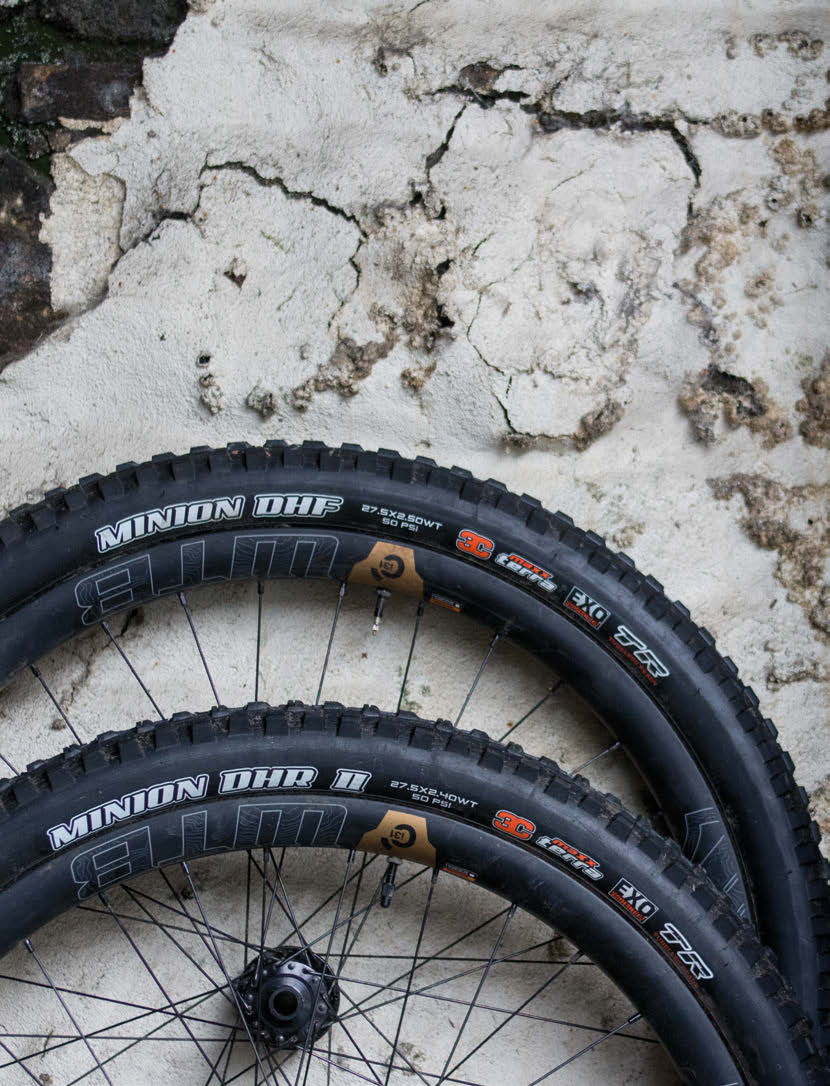
Thanks to the TCS profile, tyre installation and inflation proved to be a doddle on a variety of different tyres we tested the rims with. Those included a 2.3in WTB Vigilante, 2.5in Maxxis Minion DHF, and 2.35in Schwalbe Nobby Nic tyres. Pumping up each tyre resulted in a satisfying ‘snap!’ as the beads locked in place. According to WTB, most of the extra mass in the Ci31 has gone into reinforcing the spoke holes further, while beefing up the base of the bead hooks to increase the rim’s resilience to blunt impacts. Despite this, the Ci31 still comes with a 102kg rider weight limit. WTB recommends heavier riders consider alloy rims.
Like a good quality carbon wheelset, the Ci31s offer a snappy and responsive feel at the pedals. Compared to alloy hoops, they offer more crisp acceleration and the ability to change trajectory without hesitation. Their stiffness is both good and bad, however. In back-to-back testing with comparable alloy wheels set up with identical tyres and air pressure, there was noticeably more buzz coming through to the grips and saddle. The stiff build of the Ci31s mean they do transmit more trail feedback, and unless you’re taking charge when launching the front wheel into a rock garden, the lack of flex means you get pinballed more easily.
With the exception of the Bouwmeester Tammar and the Stan’s Bravo, most carbon rims can exhibit this kind of harshness, and especially those with a full 32-spoke build and a deep profile like the Ci31s. Then again, bigger and more aggressive riders will appreciate the ‘direct’ feel of the Ci31 rims, with their laser-like accuracy offering precise trail-ninja manoeuvres. Oh, and did I mention the Ci31s were tough? Despite our aggravated attempts, we couldn’t put either wheel out of true, let alone come close to breaking one. They are absolutely bulletproof.
Overall: A strong, stiff and high-quality carbon rim that’s ideal for 2.3–2.6in wide tyres. For aggressive riders who frequent alpine terrain, or for those who spend too much time truing their alloy wheels, the Ci31s are tough rims that are built to eat rocks for breakfast.
Maxxis Minion DHF/DHR II WT Tyres
Price: £66.00 each | From: Extra UK | Tested: Three months | By: Wil
As cassettes and fork stanchions have got bigger in recent years, so rims have also become wider. Why? Because a wider rim provides a broader support base for the tyre beads, and helps to put more rubber on the ground. The result is more stability, more traction and less casing roll with low-pressure tubeless setups. Not all current tyres play well with the latest generation of wide rims though, and so Maxxis has responded with a line of WT tyres that are specifically built for rims with an internal width of 30–35mm. Standing for ‘Wide Trail’, these tyres use exactly the same casing and construction as the regular versions, but with a different tread configuration and placement that allows for an optimised profile when mounted to wide rims.
Minion DHF 27.5×2.5in WT 3C Maxx Terra EXO
Weight: 937g // Actual width: 2.46in
As one of the most popular DH tyres of all time, the Minion DHF is also a sought-after tread for trail riders. It’s a favourite among the Singletrack test crew, and the WT version is no different – it just sits with a better profile on wide rims. With its substantial cornering blocks, the Minion delivers unreal cornering grip with a level of confidence that allows you to lean harder and push faster into questionable off-camber sections. It rolls surprisingly well, while the many edges in the blocky tread pattern deal well when scrabbling for grip in loose conditions, and the siping through the central knobs allows the tyre to pinch harder and rockier surfaces. Although Maxxis states this is a tyre that can handle wet conditions, it’s not the option we’d pick for gloopy British mud – the DHR II and the Shorty are much better foul condition tyres.
Minion DHR II 27.5×2.4in WT 3C Maxx Terra EXO
Weight: 919g // Actual width: 2.39in
Traditionally, DHF = Front, and DHR = Rear. With the newer DHR II, however, it’s just as good on the front in the right conditions. The DHR II features the same reliable cornering characteristics as the DHF, but subs in wider rectangular blocks through the centre. These rectangular blocks are siped all the way through, which increases flexibility under hard forces, like when you’re pulling on the anchors after landing on a steep transition. This increases braking traction dramatically and, along with a slightly deeper height to all the tread blocks, makes the DHR II the grippier choice in those steep and loose situations where your arse is being buzzed by the rear tyre.
While the DHR II does come in a little narrower at 2.4in, it is noticeably slower than the DHF. For longer and more undulating rides, you’ll definitely know about it. But for those riders who winch up fire roads with the primary goal of plummeting back down steep fall lines in the woods, the DHR II is a dependable pick for front and rear duty. The braking traction is insane, and while that’s traditionally the duty of a rear tyre, up front it adds a whole new level of control.
Overall: As advertised, the new Maxxis WT tyres are the choice for anyone running nu-school wide rims. The DHR II was the surprise of the two, with its incredible braking traction offering bucketloads of grip for steep and nasty terrain. For faster and firmer trail conditions, the Minion DHF remains the brilliant do-everything tread it always has been.
Ragley Wiser Bars
Price: £40.00 | From: Hotlines | Tested: Six months | By: Barney Marsh
Handlebars. Such an obvious piece of technology. The metal pole that is clamped in the middle by your stem seemingly exists for the express purpose of preventing your grips from falling to the ground. Many, perhaps, don’t give their bars a second thought. They’re well down the list when it comes upgrading; wheels, saddles, forks, chainset – all will, perhaps, be jostling ahead in the upgrade line before your capricious eye chances across your humble bike’s bar, and deems it unworthy. And bars are easy to get used to. So much so that other bars perhaps do as much to make a new bike feel alien as different shock settings, or wheel sizes. And all as a metal stick with a clamp in the middle.
And should your bar be eventually deemed worthy of replacement, your wallet is normally crowbarred open to the song of carbon, of the black and sinuous. And besides, aluminium bars are eschewed as, perhaps, too similar to the one you’ve cast aside. But that would perhaps be a mistake. There is much to recommend aluminium, after all. From its ease of manufacture, its recyclability, its ride-enlivening characteristics (for every person who applauds carbon’s ‘vibration dampening feel’, there is another who decries its ‘deadness’), the wide availability of colours – carbon is almost invariably at the ‘noir’ end of the spectrum – to, of course, its price. It’s a whole pile cheaper, after all.
These here Ragley bars, then, are aluminium. They are not too wide – 760mm – but neither, to most, are they too narrow. The width is designed to suit most riders out of the box, according to the Ragley website, although they do helpfully provide little markers if you want to cut them down. And as well as that width, they have 5° of upsweep, and are available in 11, 25 or 38mm of rise (these are 25mm). The graphics on these gunmetal grey ones appeal, too – it’s nicely asymmetric, and matte on one side; polished on the other. Subtle, true, but pleasing. And for a claimed (perfectly respectable) weight of 300g, ours weighed in at precisely 303g. Not bad.
They’re good and comfy on the bike, too. Everything falls just where you’d expect; they’re comfortable on the wrist and they impart something of a lively flavour to both suspended and rigid bikes they’ve been installed on. As someone longer of limb than usual, I’d perhaps have liked a touch more width, but it’s something I rapidly got used to, and that doesn’t necessarily apply to everyone. They’ve survived a couple of heavy impacts that had me whimpering for parts of my anatomy, and they’ve come out looking good with nary a scratch.
Overall: In short, this is a fine pair of handlebars. They’re good value, and they have a proper amount of rise and sweep. If you’re in the market for a new set of bars, and you’re either on a budget, or not at all bothered about the black stuff, give Ragley a look.
SRAM Level Ultimate Brakes
Price: £238.00 per end (rotors approx. £50.00 each) | From: Zyro Fisher | Tested: Three months | By: James
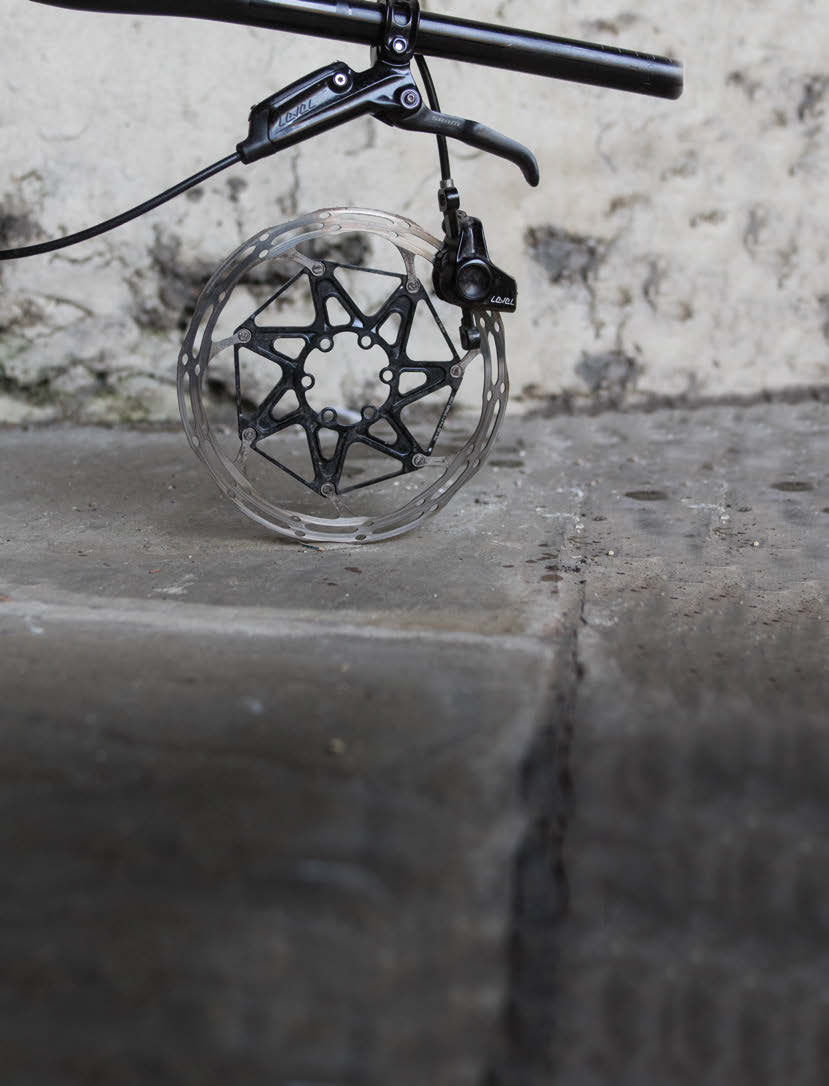
In 2014, SRAM pulled a complete U-turn on the fate of its hydraulic disc brake line when it introduced the now-ubiquitous Guide. With powerful four-piston callipers and brand-new lever internals, the smooth and reliable Guide brake has proven to be popular with trail riders and enduro racers alike. Two years later, SRAM unveiled a lighter, sleeker and smaller version called the Level. Aimed at cross-country racers and trail riders, the Level features a similar lever design to the Guide brake, but with a more compact twin-piston calliper at the other end.
As the name indicates, the Level Ultimate is the top tier model of the Level range. In essence, it’s the spiritual successor to the Avid XX disc brake, with a pared down design giving both a very clean looking and reasonably lightweight brakeset. Weight for the test pair came out at 434g, without hardware or rotors. Compare that with 406g for Magura MT8s, and 396g for Shimano XTR M9000s.
In pursuit of gram removal, a minimalist approach has been taken by SRAM’s engineers for the number of adjustments on offer. You can adjust reach for the carbon fibre lever blade with a 2mm hex key (no tools-free dial), and that’s it. For an even cleaner cockpit, combine the levers with SRAM shifters and RockShox remotes via the MatchMaker system.
In use, the Level Ultimates are incredibly smooth. And powerful. The carbon lever blade feels lovely, and a sealed pivot bearing ensures silky rotation. Although not as firm feeling as the Guide brakes, the delivery of stopping force is progressive. The Level Ultimates modulate well and they do have a resolute bite point. It may feel a little softer and lighter in its action, but it is rock-solid, and firmer than Shimano XTR.
We’ve been testing the Level Ultimate brakes on both lightweight cross-country bikes and heavy-duty trail bikes. Throughout the test period they’ve been reliable performers with a consistent delivery of power. But it’s their high-speed power and control that has surprised us most for such a lightweight cross-country brake. Even strapped to a big 29er trail bike with 180mm rotors, there’s been no lack of raw power and no issues with fading when travelling at warp speed down steep hillsides.
Rather than the quad 14/16mm pistons on the Guide calliper, the Levels feature dual opposing 21mm diameter pistons in each calliper. The body itself is made from a single piece of machined alloy, resulting in a lighter and stiffer structure that also has fewer seals overall. To manage heat build-up, the Level Ultimates run alloy-backed pads, and additional stainless heat shields between the pistons and the pads help to strip heat away from the DOT 5.1 fluid. In addition to the heat-mitigation measure, SRAM has also made these super-easy to bleed thanks to the Bleeding Edge design with its plug-in syringes. Clever, and in our experience, highly user-friendly.
Overall: While they’re superlight and targeted towards the Lycra crowd, the SRAM Level Ultimates are pure and simple – just really good brakes. They’re smooth, reliable, easy to live with, and they deliver excellent modulation and power.
Five Ten Freerider EPS Shoes
Price: £105.00 | From: Five Ten | Tested: Three months | By: James
Five Ten’s classic Freerider is a ubiquitous flat pedal shoe much loved by many mountain bikers. Popular for good reason, combining both good looks and great function – they are a versatile shoe that offers excellent feel and grip and work well both on and off the bike. The Freerider range features a number of different variants. This particular Freerider model has been designed for winter (and British) use, so is it ideal for wet and cold riding then?
EPS stands for Elements Primaloft System. It builds on the extra weatherproofing features of the Freerider Elements adding Primaloft (a synthetic insulating material with a high warmth-to-weight ratio) and packs in other heat-retaining materials and construction techniques to better deal with inclement weather. A layer of Primaloft insulation is present from the instep forward, the forefoot is one-piece synthetic leather DWR coated for water repellency and there are minimal seams throughout the shoe. Foam insulation is used in the heel and the tongue includes a layer of Primaloft, plus it is gusseted to help keep heat in and muck and water out. The heat retaining methods don’t stop there as, in addition, the footbed is insulated and heat reflective.
The classic repeating dot pattern Stealth S1 rubber is used on the sole of the shoe giving high-performance riding and hiking sections of trail and wearing well. Happily the extra materials used to keep feet warmer and drier have not added noticeable bulk – the familiar look of the shoe has been maintained and weight increase is minimal.
It’s been damp out most days the past few months (from late autumn onwards) and temperatures have been a mix of unseasonably mild and sub-zero days. Some rides have been very wet, most have been damp, there’s been some snow, lots and lots of muck and errant clart and some standing around on cold ground taking photos. My feet have been well looked after with the EPS shoes. Water has beaded off from splashes on rainy days and I have found the useable temperature range is good down to freezing.
While I wouldn’t go as far as saying that these are the definitive flat pedal winter shoe, I can attest to the insulating materials and features making for cosy, happy feet and keeping cold toes at bay. They have good keep-warm and keep-dry qualities, and work very well in cold weather when splashing through puddles. This almost goes without saying, but they are not an out-and-out winter shoe. Depends on your definition of winter riding really – if submerged and there is water ingress, then expect core temperatures to drop; they are not totally sealed and there is no neoprene collar or similar sealing shoe to ankle/lower leg. If you are after more protection from the elements, a high-top model is available which offers additional coverage.
The Freerider EPS is an excellent poor weather shoe, for cold and wet conditions, splashing through puddles and sending spray from the trail, the shoes have been ideal for keeping feet warm. When they’ve got wet, they’ve dried in good time.
Overall: For the majority of the conditions described above, the EPS shoes have worked well and been a welcome part of my riding wardrobe at this time of year. Using these shoes my feet have stayed warmer than my usual wool sock and shoe combo and that is a good thing!
Shimano Deore XT M8000 11-46 Cassette
Price: £99.00 | From: Madison | Tested: Three months | By: Wil
Designed to suit 1×11 Shimano drivetrains, the 11-46T cassette joins the existing 11-42T and 11-40T options in the Deore XT range. Compared to the 11-42T cassette, the 11-46T cassette is identical in the first ten sprockets, which are all made of steel. The only difference is in the final alloy sprocket, which offers 46 teeth, instead of 42 teeth.
For those of you doing the maths, you’ll realise that this 418% gear range falls a bee’s dick short of SRAM’s 420% range on its current 11-speed 10-42T cassettes. It’s also a way off the mark of the Eagle™ 10-50T cassette that offers a whopping 500% range. But is range the only factor in the performance of a cassette?
For a start, Shimano’s 11-46T cassette will slip straight onto a traditional freehub body, which is nice. Secondly, the shifting is silky smooth. As you’d expect from Shimano, the jumps from gear to gear are evenly stepped, and each shift is fired off with minimal noise. It’s noticeably slicker than an equivalent SRAM cassette, and this only becomes more apparent as things wear over time. Despite hundreds of kms of riding, this XT test cassette has remained quiet and smooth, with none of the ‘cracks’ or ‘bangs’ that you can get from a worn SRAM unit under load.
I was expecting there to be a lag in shift speed with the larger 46T sprocket, but my assumptions proved unfounded. That final jump is big of course, and it serves as an ideal bail-out gear for when you really have to grind into the techier climbs, but the shifting is smooth both in and out of the dinner plate, with zero hesitation from the rear mech.
The biggest improvement I found with the 46T sprocket became apparent on steady half-hour long ascents. Although I had no trouble making it up the same climbs with a 42T or even a 40T low gear previously, having the 46T allows for a much gentler sit-and-spin technique that has proven to be a dramatic saver on both the knees and general fatigue. This means I’d arrive at the top of a descent ready to rip the rollercoaster ride back down. In a group ride situation, the difference is noticeable, and going back to a bike with a 42T felt like a chore.
I’ve tested the 11-46T cassette as part of a complete 1×11 Shimano XT drivetrain, and fitted to an otherwise complete SRAM GX 1×11 drivetrain. Neither SRAM or Shimano will recommend mixing and matching components, but I can confirm that SRAM 11-speed rear derailleurs have more than enough B-tension adjustment to clear the 46T sprocket. At 441g, the Deore XT cassette comes in about 50g heavier than a SRAM XG-1150 (10-42T) cassette, but it does shift significantly better, and it’s also £20 cheaper too.
Overall: As it stands, Shimano has finally delivered the cassette option its 1×11 drivetrains should have come with two to three years ago. It shifts smoothly, offers excellent durability, and works equally with Shimano and SRAM drivetrains. Recommended.


