From the Singletrack archive: this Bike Test first appeared in Singletrack Magazine Issue 111 (2017). Words & photography by Barney Marsh. Prices and specs were correct at the time of publication.
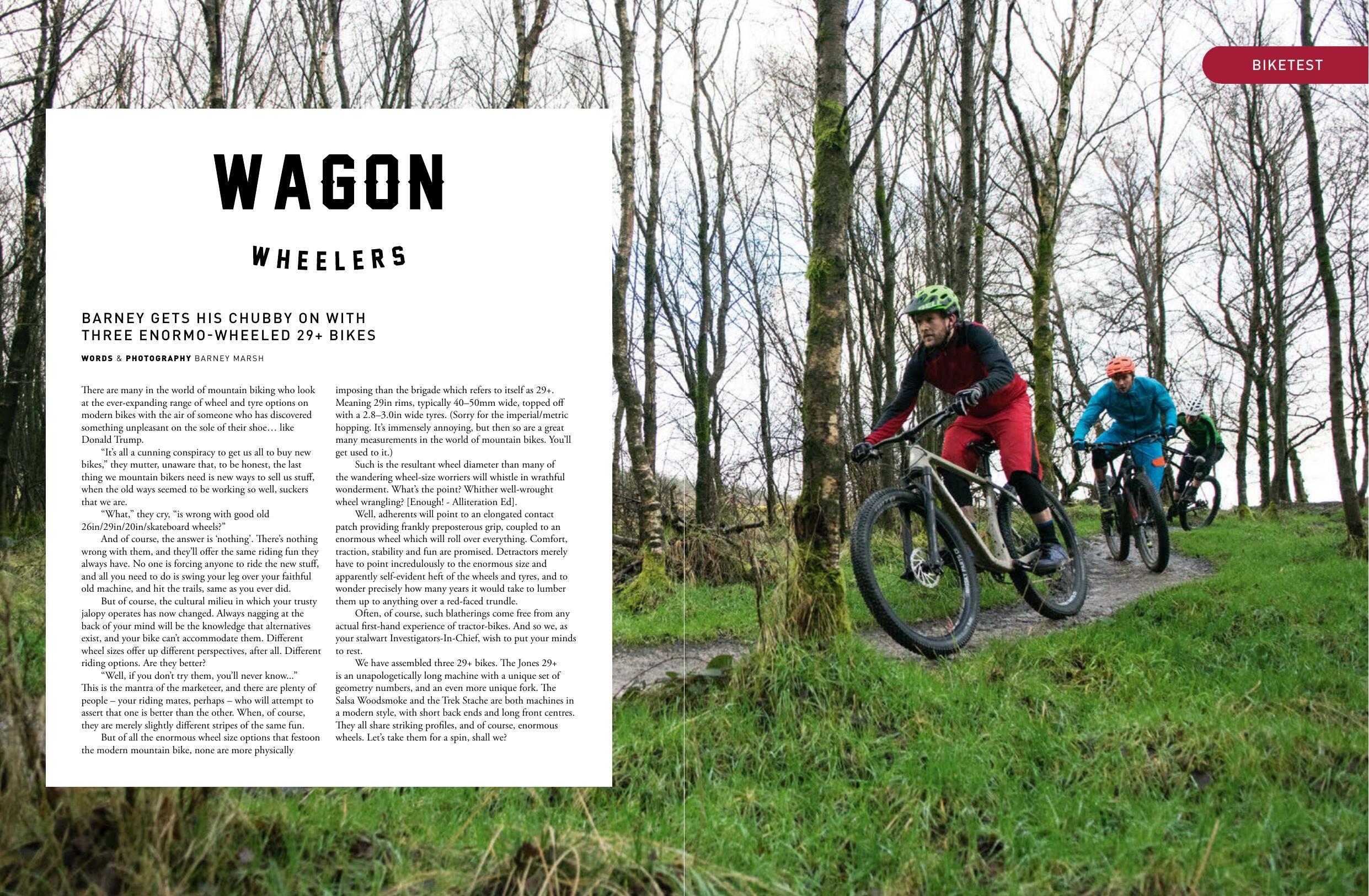
Barney gets his chubby on with three enormo-wheeled 29+ bikes.
There are many in the world of mountain biking who look at the ever-expanding range of wheel and tyre options on modern bikes with the air of someone who has discovered something unpleasant on the sole of their shoe… like Donald Trump.
“It’s all a cunning conspiracy to get us all to buy new bikes,” they mutter, unaware that, to be honest, the last thing we mountain bikers need is new ways to sell us stuff, when the old ways seemed to be working so well, suckers that we are.
“What,” they cry, “is wrong with good old 26in/29in/20in/skateboard wheels?”
And of course, the answer is ‘nothing’. There’s nothing wrong with them, and they’ll offer the same riding fun they always have. No one is forcing anyone to ride the new stuff, and all you need to do is swing your leg over your faithful old machine, and hit the trails, same as you ever did.
But of course, the cultural milieu in which your trusty jalopy operates has now changed. Always nagging at the back of your mind will be the knowledge that alternatives exist, and your bike can’t accommodate them. Different wheel sizes offer up different perspectives, after all. Different riding options. Are they better?
“Well, if you don’t try them, you’ll never know…” This is the mantra of the marketeer, and there are plenty of people – your riding mates, perhaps – who will attempt to assert that one is better than the other. When, of course, they are merely slightly different stripes of the same fun.
But of all the enormous wheel size options that festoon the modern mountain bike, none are more physically imposing than the brigade which refers to itself as 29+. Meaning 29in rims, typically 40–50mm wide, topped off with a 2.8–3.0in wide tyres. (Sorry for the imperial/metric hopping. It’s immensely annoying, but then so are a great many measurements in the world of mountain bikes. You’ll get used to it.)
Such is the resultant wheel diameter than many of the wandering wheel-size worriers will whistle in wrathful wonderment. What’s the point? Whither well-wrought wheel wrangling? [Enough! – Alliteration Ed].
Well, adherents will point to an elongated contact patch providing frankly preposterous grip, coupled to an enormous wheel which will roll over everything. Comfort, traction, stability and fun are promised. Detractors merely have to point incredulously to the enormous size and apparently self-evident heft of the wheels and tyres, and to wonder precisely how many years it would take to lumber them up to anything over a red-faced trundle.
Often, of course, such blatherings come free from any actual first-hand experience of tractor-bikes. And so we, as your stalwart Investigators-In-Chief, wish to put your minds to rest.
We have assembled three 29+ bikes. The Jones 29+ is an unapologetically long machine with a unique set of geometry numbers, and an even more unique fork. The Salsa Woodsmoke and the Trek Stache are both machines in a modern style, with short back ends and long front centres. They all share striking profiles, and of course, enormous wheels. Let’s take them for a spin, shall we?
Jones Plus
Price: £1,640.00 frameset / complete bike £3,200.00 est. | From: Biff
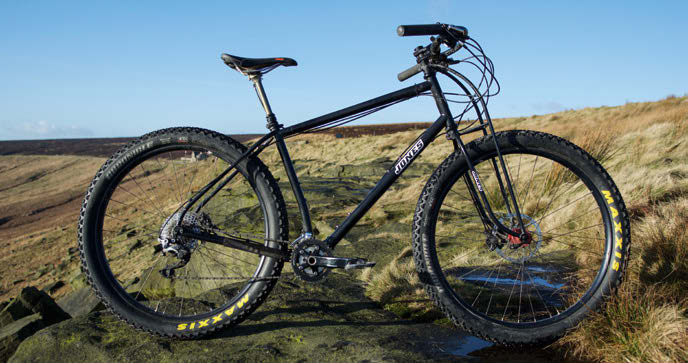
Oregon-based Jeff Jones has been ploughing his idiosyncratic furrow for a while now, and he’s garnered legions of fans by so doing. So it’s no surprise that the Jones Plus merrily goes its own way while thumbing its nose at received wisdom.
Our steel test bike is the larger of the two Plus framesets on offer, with an estimated top tube of 25 inches – the Jones website recommends altering it for riders between 6ft and 6ft 6in by changing the amount of layback on the post and the length of the stem. The frame has a 67.5° head angle, which couples with the spaceframe fork’s extraordinary 76mm of rake (the other two bikes in our test have around 51mm) and the long 482mm chainstays to make for a very long wheelbase.
The Jones is available as a frame and fork set (ours has 135mm dropouts, although new frames come with 148mm thru-axle back ends, and in a very spiffy bright green colour) so you’ll be speccing the parts yourself, but we’ll briefly touch on the components on our Jones.
First up, it naturally comes with Jones’ unusual (surprise, surprise) bars. Enormously swept back, the idea is that they offer multiple handholds, and there’s no denying they go some way to increasing the unique feel of the rest of the bike. A Thomson stem attaches this to the fork – we tried the supplied 110mm stem for the lankier of leg, and a much shorter 50mm one for somewhat shorter testers. The headtube is long at 194mm, which conspires with the dual-clamp nature of the truss fork to keep the stem high, although this is mitigated by running the bars at a slight downward angle.
A Thomson externally routed dropper post, topped with a Charge saddle, is fitted, which proved a boon. Honestly, it’s hard to think of a mountain bike which isn’t improved by a dropper. Dropper choices are slightly limited, though, as the Jones Plus runs a 27.2mm seatpost.
A Surly 2x chainset works with XT mechs, shifters and brakes to keep the Jones truckin’. The whole shebang floats on Hope hubs with Velocity Dually rims, shod with Maxxis Chronicle Plus tyres.
The Ride
So let’s swing a leg over this monster, and see what happens. Well, the first thing is that you need to leave any preconceptions by the door. The first time I rode it, the Jones felt distinctly odd. As promised on the website, there’s loads of room in the cockpit for body English, but it does feel pretty upright compared to ‘normal’ bikes, thanks to that headtube and fork. But like I say, you need to throw your preconceptions away – unusual isn’t necessarily worse…
The bars give a variety of positions, true, but they also alter the way the bike handles. Run your hands further up the bars, and the distance between them narrows as the effective stem length increases. This seems pretty well suited to long drawn-out climbs. Come to a descent, and run your hands to the ends of the bars. The sweep is such that the effective length of the stem drops dramatically, and you’re rewarded with a commensurately faster-handling bike.
That’s not to say it’s twitchy, though. The length of the Jones means it’s nothing if not stable at speed. It’s not nearly as cumbersome as I expected in tight twisty stuff once you’re used to it, however. True, the first ride or two were marred by frequent tyre scuffs when I was hoping for sinuous and silent singletrack snaking, but once I’d got my eye in things settled down nicely and it became a complete blast. It’s just a question of relearning where and when to turn, especially when coming straight from a much shorter bike.
The front end, too, initially seemed difficult to lift, but once I’d figured that my weightings needed to be slightly different (body Oregon?) things started to fit together magnificently. The rigid nature of the bike did make itself known on a couple of occasions – particularly very fast and rocky technical sections which didn’t seem to be this bike’s forte – but at least one of the reasons for this is that I was going into them far too hot, such is the Jones’ composed nature – after a while the design, and those huge wheels, instil an impressive sense of competence which is hard to ignore. The Plus operates very well in these areas at slightly slower speeds, but don’t expect to be keeping up with your full-suss mates on the very steep stuff. Everywhere else, though, they’re fair game – not bad for a fully rigid bike.
Overall, it’s unique, there’s no question about that. It excels at the smooth, the fast, and the sinuous, and it rides much, much better than a snooty, preconception-filled look over its numbers might suggest. And while many – with good reason – will take the Plus on long-distance touring epics, this is just as much a full-on trail bike. Only different.
| Frame | Jones Plus 4130 cromo | Brakes | Shimano XT |
| Fork | Steel Truss fork | Stem | Thomson X4 110mm |
| Hubs | Hope 135mm | Bars | Jones H-Bar Loop Aluminium |
| Rims | Velocity Dually | Seatpost | Thomson Elite Dropper |
| Tyres | Maxxis Chronicle Plus | Saddle | Charge Spoon |
| Chainset | Surly Mr Whirly | Size Tested | 25in |
| Rear Mech | Shimano XT | Sizes Available | 24in, 25in |
| Shifters | Shimano XT | Weight | 31.6lbs |
Salsa Woodsmoke 29+ GX1
Price: £1,799.00 (frame only) | From: Raleigh
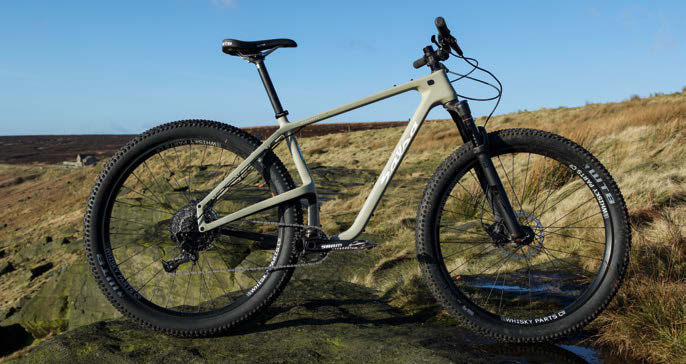
The Woodsmoke could be a tricky beast to talk about, not least because it’s actually designed to run 27.5+ wheels, 29er wheels, or 29+ wheels, thanks to Salsa’s cute ‘Alternator 2.0’ hinged dropouts. But as this grouptest is all about the 29 chubbies, my task is somewhat simplified. So, here we have a carbon frame which bears similarities to the Trek Stache elsewhere in these pages. It’s very much a modern bike; it’s Boosted, and although the reach is not the very longest, it adheres to a more modern template nevertheless: it ain’t short either. Our large test bike has a 453mm reach, and the top tube couples a 67.8° headtube to a 73.3° seat tube. The Woodsmoke has a ridiculously short 417mm chainstay length (and that’s with a 29×3.0 tyre, remember – it can drop to a mental 402mm if you run standard 29er tyres), which is enabled by a spectacularly elevated driveside chainstay and a very bent seat tube. This last can take a front mech if you’re so inclined; you’re not just forced to run 1x gears.
Speaking of which, our test Woodsmoke came equipped a full GX 1×11 drivetrain, and lots of other SRAM kit – Level Brakes, and RockShox Yari RC Solo Air fork with 120mm of travel. There were four travel tokens initially in our fork, as well as a further two in the box, which gives you lots of room for adjustment, to put it mildly. It’s well worth fishing a couple out if your dealer hasn’t already and experimenting with the fork set-up.
Rims are Salsa own-brand hubs laced with 32 spokes into Whisky Parts Co alloy rims shod with WTB Ranger 3.0 tyres. A relatively short (for an XL frame) 350mm non-dropper seatpost and a WTB Volt Comp saddle gaze longingly at a 50mm stem and a 740mm bar they’ll hopefully never meet.
The Ride
First impressions? Well, I admit to recoiling a little when I first saw pictures of the Woodsmoke. That elevated, tangential chainstay certainly makes the bike – uh – interesting to look at. But the bike has a number of features which mitigate this initial ‘erk’. Firstly, as is the way with so many bikes with a questionable aesthetic, it’s actually somewhat prettier in the flesh. Secondly, you can’t actually see the chainstay when you’re riding it, unless your riding technique is spectacularly different to mine. And thirdly, it works really rather well.
There’s a good amount of room in the cockpit (although personally I’d like to see some slightly wider bars), and the geometry of the bike seems well suited to a variety of applications. No, it’s not a full-on techfest screamer – although it acquits itself really rather well in these circumstances – but it occupies an impressive middle ground, which lends itself to all-day wandering (it can take three water bottles!) and short blasts alike.
Spinning it up, the increased mass of those wheels is initially cumbersome, but once you’re cruising at anything other than a snail’s pace the extra weight seems negligible; the bike feels nimble and, if not quite whippy, then certainly tractable. Take it along some tight, twisty singletrack and it turns with alacrity, accelerates well, and the back end is flickable. It’s more than a little impressive – especially as before riding the Woodsmoke your opinions might veer towards the ‘tractor-tyres bike won’t steer’ school of thought. But oh yes it can. And while it’s not exactly a direct competitor to a full-suspension bike, it can ride the rocky stuff impressively briskly – that enormous tyre circumference and the extra squish of the tyres serve to smooth out the nastiest of edges, as long as you don’t forget it’s actually a hardtail, as I did on a couple of occasions. Ahem. It took me a while to get the tyre pressure dialled – there’s a narrow sweet spot between too hard pogoing and too-soft squirminess – but they gripped amazingly well and even cornered acceptably in the glop. I like the Yari fork a lot, and once I’d fettled the fork to my liking (removing a couple of those tokens to yield a more linear rate) it rewarded me with reliably stiff and supple plush travel.
Downsides? Well, I had to swap the seatpost out for a longer one – the 350mm one supplied really doesn’t cut the mustard if you like your bikes slightly smaller with loads of standover – but honestly the first thing you’ll probably be doing is fitting a dropper post anyway – the Woodsmoke is capable enough that its absence is obvious. I’d like a wider bar, as I’ve mentioned, and although I don’t ride particularly heels in, I noticed a small amount of heel-rub when I was riding with SPDs. When I rode the bike with flats, though, this disappeared.
Overall there have been some compromises in the build to get it to a price – mainly I’d have liked a dropper seatpost – or at least a longer one – but if you can get over the divisive aesthetics, this is an impressively versatile piece of kit.
| Frame | Woodsmoke carbon, boost | Brakes | SRAM Level |
| Fork | RockShox Yari RC Solo Air 120mm | Stem | Salsa Guide |
| Hubs | Salsa 32h 110mm/148mm | Bars | Salsa Rustler 3 |
| Rims | Whisky Parts Co alloy | Seatpost | Zoom 30.9 350mm |
| Tyres | WTB Ranger 29×3.0 | Saddle | WTB Volt Comp |
| Chainset | SRAM NX1 | Size Tested | L |
| Rear Mech | SRAM GX1 | Sizes Available | XS, S, M, L, XL |
| Shifters | SRAM GX1 | Weight | 30.75lbs |
Trek Stache 9.8
Price: £3,500.00 | From: Trek Bikes
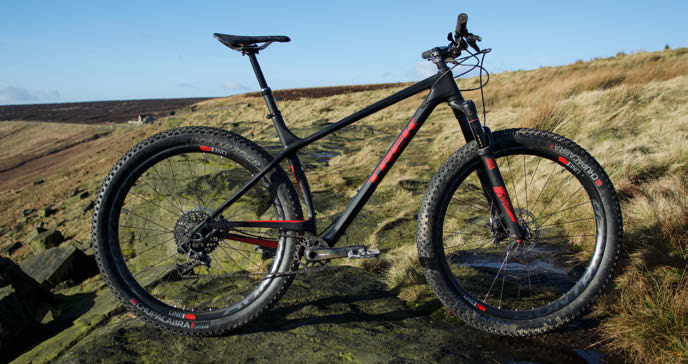
For many, the Trek Stache was a sign that the 29+ ‘thing’ was going mainstream. For such a large manufacturer to throw its weight behind what heretofore had been a profoundly niche endeavour made many people sit up and take notice, as did the increasing numbers of enthusiastic advocates. But once you’ve invested in something, you’re almost duty bound to extol its virtues. And our test Stache has many, many virtues, at least on paper.
The frame is made from Trek’s OCLV (optimum compaction, low void) defence grade (apparently) carbon, so it’s strong and light – and it’s formed into a frame that is very distinctive looking. Everything is Boosted, of course, but the obvious distinction is an elevated chainstay, which runs parallel to the chain. This last takes some getting used to, sure, but to these eyes it’s a little easier to look at than the Salsa Woodsmoke’s back end. Trek calls this the Mid-Stay, and it’s also home to some internal cable routing for the rear mech. It’s not all that long either – that altitudinous chainstay keeps the rear end tucked in as close as possible, so you get a 420mm back end, which would be more than respectable on a bike with wheels considerably smaller than these. Effective seat tube angle is 73.5° and the head angle is 68.4°. Reach on our XL test bike is 470mm, which is fairly normal for this size of bike.
As befits the flagship of the Stache range, the 9.8 comes with some pretty serious gear draped all over it. The drivetrain is a mix of SRAM’s X01 (rear mech) and X1 (er – pretty much everything else), with SRAM’s Guide RS brakes.
Front end boing is taken care of with RockShox Pike RC Solo Air fork with 120mm of travel, and effective rolling is provided with Bontrager Lone Pro 40 wheels, which have some very pretty carbon rims, laced to some very flashy hubs – all brushed aluminium, carbon and straight-pull spokes (28 of them). Tyres are Bontrager’s Chupacabras in a 29×3.00 size – so plenty fat.
And given that Bontrager is Trek’s house brand, there’s plenty more Bontrager to come too. A Bontrager Montrose Elite saddle is fitted to a Bontrager Drop Line stealth dropper post with 125mm of travel. The stem is a commendably brief 35mm long number from (take a guess) Bontrager (yay!) that holds a Bontrager carbon bar, which keeps your pinkies 750mm away from each other.
The Ride
It’s an impressive looking bike, once you’ve got over the initial confusing looks. This is, after all, an XL, but despite this the wheels still look completely enormous. But you do get used to it, and the bike even starts to look purposeful after a while.
Those carbon wheels assist acceleration tremendously, and it seems to be a running theme that 29+ tyres don’t drift in corners to quite the extent that 27.5+ wheels can. Regardless, the Chupacabra tyres rewarded straight-line effort with scads of grip, even in clart, and cornering was a happily predictable experience. Climbing was actually almost (dare I say it) fun!
The short back end made lifting the front of the bike an effortless experience, and, much like the Woodsmoke and the Jones, it was a joy on twisty singletrack.
The Stache also felt surprisingly confidence-inspiring when the trail got a little more rowdy. It was easy to forget you were riding a hardtail at times, and the scant relative weight of the bike, coupled with those huge tyres made it seem to float effortlessly over much more gnarly terrain than I expected. I even took the Stache down to the local dad-jump spot, where it acquitted itself admirably (even if I did not) – it’s well weighted in the air, and with a fraction more air in the tyres than usual there was little of the predicted squirm even upon my frequent squiffy landings.
There’s no provision for a front mech, so you’re stuck with 1x drivetrains, but, despite this, the 1×11 cassette with a 30T chainring felt just about right. The gap between the elevated chainstay and the chain seems a little tight in some gears which made me curious about whether the frame would accept SRAM’s new 1×12 Eagle transmission, but Trek assures me that Eagle works fine, at least with a 30T chainring – it didn’t have any info to hand about any larger rings – but what sort of a monster puts large chainrings on a plus-bike anyway?
I can’t say I was remotely fond of the saddle, and after a few rides in appalling weather I’m afraid to say that the seatpost stopped working. However, unlike many dropper posts, servicing it is a straightforward task that’s easy to do at home, so it’s less of an issue if you keep an eye on it.
Overall, I was surprised and extremely impressed with the Stache. I admit that I was sceptical when I first rode it – the Trek was my first experience of 29+ bikes after all, but it completely won me over after a ride or two. It’s a monster truck that rides like a sports car. Boom.
| Frame | OCLV Mountain Carbon, boost | Brakes | SRAM Guide RS |
| Fork | RockShox Pike RC Solo Air 120mm | Stem | Bontrager Line Pro 35mm |
| Hubs | Bontrager Line Pro Boost | Bars | Bontrager Line Pro |
| Rims | Bontrager Line Pro 40 OCLV | Seatpost | Bontrager Drop Line |
| Tyres | Bontrager Chupacabra 29×3.00 | Saddle | Bontrager Montrose Elite |
| Chainset | SRAM X1 | Size Tested | XL |
| Rear Mech | SRAM X01 | Sizes Available | XS, S, M, L, XL |
| Shifters | SRAM X1 | Weight | 28.5lbs |
Verdict
Testing these bikes has been a very pleasant surprise. I have to admit to a degree of scepticism when I was approached to do the review, but it’s always nice to try something new and it’s even nicer to have your preconceptions completely blown away. Initial criticisms and reservations were very much the same as the ones which greeted 29ers when they first appeared, and centred on spinning wheels up to speed and sloth in tight corners. I’m happy to report that with a little focus and practice, the heavier wheels mean little in the overall scheme of things, and cornering is absolutely not an issue. Once again, good design can completely mitigate potential issues when it comes to handling, even if the eventual products look surprisingly different to each other.
So if you’re at all curious, get thee to your local bicycle retail emporium to give one of these 29+ monsters a try. They’re not necessarily the future, but they’re certainly a future, and judging by their popularity they’ll be here for a long while yet.
Jones Plus: The Jones Plus is perhaps the most outré of the bikes here, despite looking (from the stem back, at any rate) the most conventional. Huge fork rake, weird fork, loooong chainstays, and a resultant whopping wheelbase. This, surely should be an absolute cow to ride? Well, no. No, it’s not. Granted, it doesn’t feel like any bike you’ve ridden before, and you’ll need to learn how to coax the best out of it, but when you do, you’ll find that its best is very good indeed.
Salsa Woodsmoke 29+ GX1: The Salsa Woodsmoke cleaves to the ‘short back end; long front centre’ paradigm, and how. The back end is insanely short, and is even shorter if you run it (as you can) with 27.5+in or ordinary 29in wheels. But it handles beautifully, corners well, grips like a gecko on sandpaper and is generally a hoot to ride.
Trek Stache 9.8: As, frankly, is the Trek Stache. The numbers are pretty similar to the Woodsmoke, and it boasts a slightly less – um – divisive back end, which also serves to slam the rear wheel as close to the seatpost as it can. So it’s no surprise to say that it rides as well. It accelerates, corners, climbs and descends like a much more conventional feeling bike, but with the added traction bonuses that the huge tyres confer. And it has the bonus of a smattering of extra carbon to keep the weight down where it’s important.


