UPDATE: Reviews section refreshed, redesigned, searchable: Go take a look
The ways in which the varying views of 'nature' and how we relate to it have changed - and, thus, our view of what is (and what is not) sustainable or sustainability has changed.
What do you think have been the main reasons for the changes over time?
ive gone for Population increase.... more people = more space needed for development = less space for any "naturey" things?
We used to be scared of the countryside, and nature. Then we tamed it, and then dominated it. So now we have a more romantic view. Plus 90% of the people now live in urban areas.
There is almost no land unshaped by man in the UK - you know those desolate highland empty spaces - used to be full of trees.
Ben Lomond is now only several feet high due to mtb erosion.
Are we writing an undergraduate human geography essay for you?
well no, its for a forum, ive already written my piece for it, though being the keen bean i am, im the first one to have done so, and fancy seeing what other people think!
Fair enough, i just had various lectures on this topic! It's all cyclical, i think (hope) the more enlightened among us at least are regressing to a view of nature similar to the 18th and 19th century romantics.
Thoreau said "wilderness is the salvation of the world."
I wouldn't listen to him, the documentaries are funny but he uses easy targets.
I dont think that, in the grand scheme, the higher population has really expanded its area by the factor you suggest, main expansion is in cities at higher densities, there has been expansion of the urban fringe but not to such a huge extent that its overtaken the huge swathes of countryside that were always there.
Key reason for the change in view is the migration to cities - if anything there's less people living in the countryside than before, and those people are removed from nature on a daily basis (prepackaged meat and veg)
sustainability is a complex one, as are you talking about on a global scale (climate change) or on a local scale? As a society we are unwilling to accept that population crashes/fluctuations are a natural part of the cycle, that the true limitation on any species survival are food resource and disease.
When a species outstrips and destroys its environment and food resource, then its population crashes, and the population crash allows the environment to recover, then the species starts recovering and we're back to the start - boom and bust since time immemorial.
we foolishly fight against this in the human race out of a sense of humanity, and we fight against this in wildlife in an extremely anthropomorphic manner - like Canute trying to repel the tide, we only make things worse for ourselves and other species in the long term
At the current rate of use, the word "sustainable" will be worn out by 2015.
Cynic-al, I assume you know she meant Henry David Thoreau 🙂
Interesting article in the Guardian the other day, about the non-rainforest wilderness in Peru. It's being slashed and burned by ranchers but also fundamentalist Christian Mennonites. They justify their actions by quoting the bible where it says people have to go and 'look after' the land.
Now being an old fashioned lot, they seem to have an old fashioned idea of 'looking after' land. In years gone by people thought that cultivating it was looking after it; if you left it be you were abandoning it to become wasteland.
Now we have completely the opposite idea...
Now being an old fashioned lot, they seem to have an old fashioned idea of 'looking after' land. In years gone by people thought that cultivating it was looking after it; if you left it be you were abandoning it to become wasteland.Now we have completely the opposite idea...
Not quite - you'd (probably) be amazed at how much [i]management[/i] goes on in so called natural places. Everything form excluding deer to reduce grazing pressure (in large part of the Highlands) to introducing ponies to increase grazing pressure (for some grassland communities) in southern parts.
Beaver / Red Kite / Bustard / Sea Eagle reintroductions anyone?
Its all gardening.
Not quite - you'd (probably) be amazed at how much management goes on in so called natural places.
No I know that, but that's only done through necessity and most conservationists would rather it wasn't needed at all. And it's all about getting it closer to what it would be if we hadn't 'looked after' it in the first place.
what oo00oo said.
TandemJeremy - Member
There is almost no land unshaped by man in the UK - you know those desolate highland empty spaces - used to be full of trees.
...AND people who were forcibly removed to make playgrounds for the hunting fishing idle rich.
...AND people who were forcibly removed to make playgrounds for the [b]riding[/b] rich.
[img]  [/img]
Not quite - you'd (probably) be amazed at how much management goes on in so called natural places.
Mainly because we ****ed it up by getting rid of apex predators that would control the population, and the fact we'd rather a small amount of nature stays where 'it's supposed to be', rather than compete with agriculture too much.
AND people who were forcibly removed to make playgrounds for the hunting fishing idle rich.
...ironically, helping the natural environment in the process (in places).
Prince Charles thinks sustainably. At least he is used to thinking about generations, not a few years.
You make some fairly large assumptions there OP (maybe deliberately). Have a look at your own question as it suggests some of your answers in itself... Who are 'we'? What is 'it'? The debates on what can be thought of as 'sustainable' or 'sustainability' remain to a large extent separate to the first two questions (at least in mainstream scientific/media/popular discourses) so I'll ignore them for the moment.
What I'm trying to get at is that your initial premises rely upon a nature/culture dichotomy (along with an essentialising conception of who 'we' are and how 'we' act, but lets leave that for now) which has been extensively critiqued, and if you look into it, it's fairly obvious why. Basically (though there is a significant degree of difference and approach in these critiques) part of what they are into is the rejection of views that position humans and culture distinct from, or in opposition to nature. Instead nature is understood to be inseparable from culture, both physically and conceptually.
To begin to understand how the non-human cannot be physically independent from 'us', (which is relatively easy to conceptualise- and obviously, we are significantly 'natural' in all senses genetic/biological/chemical...) consider the global effects of human actions that demonstrably alter the 'natural' world- eg radioactive fallout, anthropogenic climate change etc- witness environmentalist obituaries mourning “the end of nature” for precisely these reasons). Conceptually (which is a more complex point but might be summarised briefly), humans as organisms cannot be considered 'unnatural', conceptions of 'nature' can only be formed and interpreted through the social and cultural- conceptions of nature and society are always implicate in each other (the concept of nature relies upon socially constructed ideas of nature in order to know itself, and vice versa).
Thinking along these lines is a lot more interesting, and potentially more productive, than seeing nature as something other to us that we '[i]dominate[/i]' (as people have commented above) or lamenting the loss of an imaginary that never was ([i]oh no, we're all so modern/urban/non-hunter-gathering[/i], again commented above). There are loads of potential reasons why the standard discourse is dominated by these “narratives of loss”, paralleling the mythical fall from Eden, descent of modern man, and so on... that make these debates quite appealing to everyone who has a love of these type of stories (myself included).
IMO understanding things from a nature-culture perspective is significantly more promising when it comes to answering questions of sustainability. But I'll not go into that now.
Sorry for the long (and probably dull) answer, I'm on my own at lunch.
At the current rate of use, the word "sustainable" will be worn out by 2015.
Sorry to break this to you Surf-Mat but your calculations are wrong, the use of sustainability depleted the resource to such an extent that environmentalists were forced to move over to ecosystem services in the early years of the 21st Century.
Which now poses the big question of should you put a price on value? A lot of work is being put into quantifying the value of the natural environment. The idea being if we price it then people will understand it in monetary terms and value it. What actually seems to happen is something along the lines of...
Environmentalist: This is valuable - look it would cost you X to do it / it saves you X because its here.
Business: Oooh its worth X - lets sell it.
Capatilism at work.
Environmentalist: This is valuable - look it would cost you X to do it / it saves you X because its here.
Business: Oooh its worth X - lets sell it.Capatilism at work.
Indeed, which is why the ecological record of the soviet union's military/industrial complex was second to none.... 🙄
http://www.springerlink.com/content/n2114442u4466186/
Living in a city is unacceptable if your rural/wilderness idyll no longer exists anywhere. Same goes for wildlife - I've never seen a tiger, but I will be depressed when they become extinct.
do you not think ideas about nature and sustainability have chnaged due to us having something approaching the first clue about ecology now. To my mind peoples views have changed due to a greater understanding of the science.
molgrips - Member
'AND people who were forcibly removed to make playgrounds for the hunting fishing idle rich.'
...ironically, helping the natural environment in the process (in places).
It's no more natural now than it was then.
The big estates put a lot of management into them.
If we want natural environments, then we need to neglect them.
Wow crouch tater, quite a answer there.
environmentalists were forced to move over to ecosystem services in the early years of the 21st Century.
Ha lol, 'ecosystem services' is great isn't it. As if there is another ecosystem we could choose to use?!
I was under the impression that managed grouse estates have more biodiversity than agricultural land use patterns. I know it's not natural, but it's better than sheep desert isn't it?
I was under the impression that managed grouse estates have more biodiversity than agricultural land use patterns. I know it's not natural, but it's better than sheep desert isn't it?
depends on the type of agriculture going on, if the in-bye land is not intensively managed for silage then the capacity of the farm to over winter livestock is considerably reduced thereby largely leaving the moorland free from overgrazing.
surely the idea of ecosystem services is largely the same as sustainability except with the ability to put a value on something?
natural, a widely used term I've never been able to understand.
molgrips - Member
I was under the impression that managed grouse estates have more biodiversity than agricultural land use patterns. I know it's not natural, but it's better than sheep desert isn't it?
What sort of biodiversity? Grouse and red deer?
It wasn't sheep desert before the people were moved. In many cases they were moved to make room for sheep.
molgrips - Member"AND people who were forcibly removed to make playgrounds for the hunting fishing idle rich."
...ironically, helping the natural environment in the process (in places).
Hardly - Native tress removed to make way for deer and sheep grazing. The land while not natural was more diverse and more natural before the highland clearances sustaining greater biodiversity than now.
molgrips - MemberI was under the impression that managed grouse estates have more biodiversity than agricultural land use patterns. I know it's not natural, but it's better than sheep desert isn't it?
Nope - monoculture of any kind is bad for bio diversity and grouse moor are monoculture. Most agricultural use you get diversity field margins, copses of trees, variation in vegetation.
actually grouse moor is very good for biodiversity and your hardly likely to get field margins on the moorland are you. They need variation in heather growth stage achieved through burning to provide a suitable nesting and feeding ground for grouse.
AA - that is what the shooting estates would have you believe but. Grouse moors are very impoverished places. Molgrips said they are more biodiverse that agricultural land - simply not right.
How can a huge area with nothing but short growth heather be any good for biodiversity? No variation in plant species= no variation in animal species. to get biodiversity you need diversity of habitat. Variation is species. You dont get this on grouse moors.
Don't be suckered by the shooting lobby propaganda.
I remember a couple of years back Pop stars was paying an charity
to plant trees in peat fields, it did not work but they had to loose
the money some how.
Sustainable is bit of a joke, they chop hardwood and good soft woods trees
down and plant them with crap fast growings trees of no value apart from
using them for MDF or particule board.
No variation in plant species= no variation in animal species. to get biodiversity you need diversity of habitat. Variation is species.
Local biodiversity over a 1 mile radius, 10 mile radius, 50 mile radius, regional, national, continental or global TJ?
One simple example - red squirrels and Upland forests!
according to your ethos, these monocultures would be an ecological desert, however they are the last redoubt of red squirrel populations in England - increased local biodiversity with introduction of large seeded broadleaved species leads to the immigration to the area of greys, and the resultant loss of reds - so, your cry for local biodiversity leads to the further reduction and fragmentation of populations in an increasingly endangered species, and therefore a LOSS of bidiversity on a regional and national scale.
Biodiversity is a red herring, as it needs a "scoring" system to prioritise for wider goals, rarity and extinction threat.
Now, where are the main UK breeding populations of Oystercatchers, golden plover, ptarmigan, red grouse, black grouse and hen harriers? oh, yes, grouse moors... So, lets break up the grouse moors to reach your biodiversity goals... oops, where are those healthy populations now? gone!
Zulu 🙄
Of course the only habitat for iconic British birds is impoverished eroded monoculture short growth heather.
Piffle - as I showed yo last time #you tried to assert this
Go on TJ 😆
the RSPB sponsored joint raptor study thinks you're talking shite:
http://www.langholmproject.com/otherwildlife.html
Curlew, golden plover and lapwing all bred in good numbers on the moor through the 1990s but appear to have declined after the gamekeeping stopped in 1998.
[img] 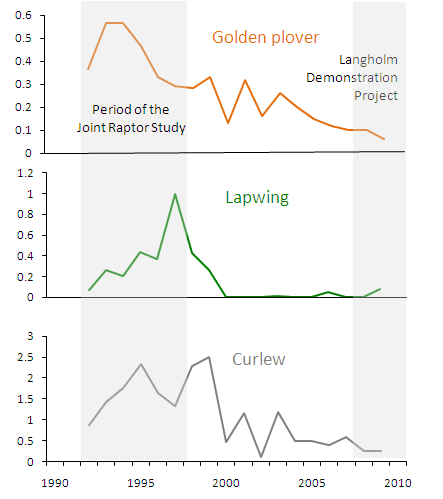 [/img]
Now then, as I said, what scale are you discussing biodiversity over? local or national?
BTW - you're still talking bollocks anyway, as no keeper worth his salt wants huge areas of short cover heather - it leaves the chicks exposed to poor weather and predation, thats why they burn in strips to create a mosaic of varying length heather growth - your lack of knowledge of what you're talking about is showing through TJ, mainly because you're more concerned with your Wolfie Smith outlook on society than facts!
And that does not show or state what you claim
What it shows is if you manage grouse moors with the intention of increasing populations of a small number of bird populations you can - it does not show that grouse moors are the best habitat. That exercise was an exercise in reducing the adverse effect of grouse moor / heather monoculture on bird populations - it showe the opposite of what you claim
Still - yo are never one to let the facts get in the way
Nor did I claim what you said I did
You're still digging your own hole TJ
monoculture of any kind is bad for bio diversity and grouse moor are monoculture. Most agricultural use you get diversity field margins, copses of trees, variation in vegetation.
Yes, but Grouse don't live on field margins and in copses of trees do they?
Nor do Hen harriers, or golden plover!
So the [b]scale[/b] on which you base and measure your biodiversity plan is vital isn't it, as without the grouse moors you don't have any grouse or hen harriers, which sort of shags the concept of biodiversity!
Yes, we've destroyed the grouse moor by planting trees and improving the grassland with fertiliser - we've gained pheasants, magpies and pigeons (three species up) , but lost the UK's last breeding populations of ptarmigan and hen harrier (two species down) - fantastic, thats a fifty percent increase in biodiversity, well done, tea and medals all round, here, have an OBE
Variation is species
Look, by introducing grey squirrels to this caledonian pine forest I can increase the biodiversity of squirrel species by fifty percent! - Congratulations!
Wow, amazing, by getting a pet cat, I can increase the biodiversity of my garden by one extra species!
Twerp!
If we want natural environments, then we need to neglect them.
Except we've already made it impossible to do that. By removing apex predators such as wolves, we've removed the only natural controls on large herbivore numbers, short of letting them eat themselves (and everything else) out of house and home. The trouble with wolves and bears is that they might eat us too, which starts to make this a little tricky; so instead, we play the part of the wolf, and cull deer numbers to keep them under control.
TJ's comments are the best though...
How can a huge area with nothing but short growth heather be any good for biodiversity? No variation in plant species = no variation in animal species. to get biodiversity you need diversity of habitat. Variation is species. You dont get this on grouse moors.Don't be suckered by the shooting lobby propaganda.
- a somewhat subjective classification?!?the best habitat
Do you walk / ride in these 'moncultures' with your eyes shut?grouse moor / heather monoculture
Grouse moors are some of the most biodiverse ecosystems in the UK. Oligotrophic (impoverished) areas generally have more species as the lack of nutrients prevents dominance of one vegetation type. There are many different species of mosses, lichens, grasses, sedges and flowering plants up there that if the heather were allowed to completely dominate would simply disappear. These support a myriad of inverts, birds and mamals that your blinkered view simply appears to miss. Strip burning / cutting keeps them that way.
Managed? Yes.
Impoverished? Yes.
Lacking in diversity? Only for those of us with our heads so far up the 'green' lobby we hate to see that the science actually supports the toffs with their guns. I'm afraid on this one, you really are talking from your posterior. (Although I suppose distributing lead across an acid soil probably isn't too great either)
In turn I guess, this heather domination would indeed lead to afforestation through succession in places below the 'tree line', but the changes this would bring downstream would majorly affect the rest of the UK. For starters, the trees would drop the water table and dry out the peat. This in turn would cause the carbon stored there to be lost (ironic, given that planting trees allegedly equals C seqestration), and nitrous oxide emissions would go through the roof too. You'd reduce water flow downwards, especially in low-rainfall years. This would not only affect us, but downsteam ecosystems too.
As a whole, the UK has been a managed landscape for such a long period of time that it is impossible to reverse without simultaneously restoring the 'original' balance in each ecosystem we have changed. Only now do we grasp enough of the science behind the ecology to realise that whilst some of the land use changes of the past may not have been great, a blanket 'return to nature' approach would probably be a lot worse at any sort of level we could possibly achieve today. Ecological re-engineering is something that rarely works as you'd expect.
zokes - a far better response than I was going to throw at TJ. I hope he stops and reads it rather than googling for more 'research' to support his own achingly class-warrior and urban stance.
zokes - Member
'If we want natural environments, then we need to neglect them.'
Except we've already made it impossible to do that. By removing apex predators such as wolves, we've removed the only natural controls on large herbivore numbers...
There was an apex predator removed that managed large herbivore numbers much better than wolves. It was the native highlander. Burnt and beaten out of their homes so that the big landowners could create this "wilderness". Also removed were the large herbivores - the highlanders cattle - to make way for the more profitable sheep.
If we want to re-introduce the ultimate apex predator, how about we dispossess the large landowners and return the land to the descendants of those who were turned off it.
epicyclo - apart from being able to put down the large chip on your shoulder, what you'd be doing there is simply recreating another managed landscape, just managed by someone else's idea of 'nature'.
I don't disagree with your point per se, but it's got bugger all to do with the question here. Replacing humans with humans - you'd still be managing the landscape, and assuming that 'the descendants' don't want eating by wolves / bears, the natural apex predator would still be lacking. You'd just have a few poor people culling deer instead of a few rich people
Humans aren't very good apex predators, since they tend to exterminate all the others and also destroy the natural flora to grow crops on.
Not that I am suggesting the Clearances were anything other than thoroughly despicable, but humans don't mix with pristine ecosystems, do they?
zokes - Member
epicyclo - apart from being able to put down the large chip on your shoulder, what you'd be doing there is simply recreating another managed landscape, just managed by someone else's idea of 'nature'...
I've got a right to that large chip - my family are from those dispossessed people.
Of course it would still be a managed landscape. It always has been. Humans are part of it. That is the point I'm trying to make.
Fiddling around the edges trying to create an urban dwellers romantic idea of wilderness/nature or make it more "natural" is bollocks - it is and was agricultural and pastoral land people made a living from.
It has not been a "pristine ecosystem" for thousands of years.
Heh.. just read the stuff I missed last night when TJ waded in. Most people back down when they are shown to be on shaky ground 🙂
It seems to me that game bird management can be good for biodiversity (I've seen loads of pheasant estates down by me with dozens of different plant and tree species being planted for the sake of birds) but I'm sure there are certain spots where it's not.
However on the hills of Wales it's nothing but sheep and grass - this is about the least diverse habitat in the whole country I'd wager. Personally I'd rather our hills had more game shooting. As long as they don't close off the trails too often 🙂

