UPDATE: CLASSIFIEDS section refreshed, redesigned, searchable: Go take a look
IIRC, a smaller rotor will actually make the problem worse because there’s more leverage
You do not recall correctly. A moment is the product of force and distance therefore the greater the distance the greater the leverage.
You aren’t going to stretch a steel skewer beyond its elastic limit with your hands.
Who said it was hand tight? If you horse it up in the open position then use a pipe or something to cam it over I'd place money on it failing sooner or later.
No offense to the OP I'm talking about but people can be proper ham fisted idiots. I once immobilised an entire ship because I didn't fully disengage the (several storey) engine barring gear before winding it out by hand which resulted in a twisted mess that needed the fitter to gas axe it to get under way.
Ignorance makes people do dumb things, myself included.
Good QRs, lawyer lips etc all reduce it and in the case of a good QR can eliminate it but QRs and discs are fundamentally a bad solution
To be fair, the early days when suspension and then disc brakes were just coming into MTB, manufacturers didn't realise the potential for that issue. It was something that had worked absolutely fine on rim-brake forks for decades and then discs and suspension came along and sort of created the problem.
The forks on my old gravel bike had forward-facing dropouts, never had an issue with them.
Cotic, for a while, produced the RoadRat with a disc rotor on the right hand fork leg to reverse the forces (given that it still used a QR fork/wheel).
It's quite staggering how many people file off the tabs on forks while thinking they're such good mechanics that they don't need no American lawyer telling them what to do.
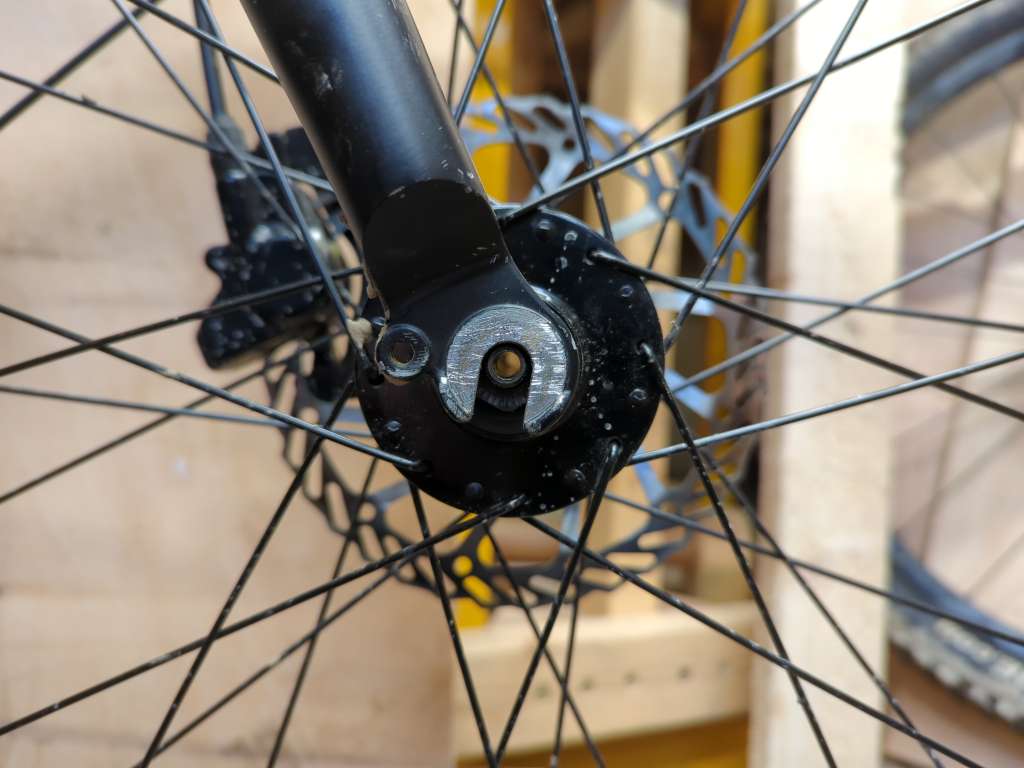
And it's a new bike? That shouldn't be on the market... in my opinion... they have had years to spec the forks with a forward facing dropout, if they can't make the money work to have a captive axle at the price point they're aiming at. Very poor. Shimano steel QR with its knurled closing face should look after you still... but, well... that fork's way out of date, even really cheap bikes should be safe. No upgrades should be required just to keep the wheels in. No excuses.
You do not recall correctly. A moment is the product of force and distance therefore the greater the distance the greater the leverage.
Not quite. The leverage is the ratio of the two distances. If you make the distance from the axle to the dropout smaller, you increase the leverage because the distance from the tyre to the dropout is the same. The ratio of the two increases.
XTR M970 QR Skewers were the apex of QR.
Very much so. And I'm still using some!
How does anyone expect new designers to work it out when the bike industry has spent 20y resolutely denying there’s any issue to address?
Goodness - even an idiot can tell that’s a bad design! As soon as you hit the brakes, the brake pinch point becomes the pivot point and the axle will try to move. In this case, is almost free to move down the slot with only clamping force to resist its motion. With a normal (forward dropout), the reaction force pushes the axle into the back/lower leg of the dropout.
Time for a visit to Halfords? Or just buy a new fork?
A point to the person who mentioned the drop outs angled slightly backwards 🙁
That is truly shocking 😯
Not quite. The leverage is the ratio of the two distances. If you make the distance from the axle to the dropout smaller, you increase the leverage because the distance from the tyre to the dropout is the same. The ratio of the two increases.
Well ****.
You know, I've never thought of the other half of the lever in your analogy.
I've literally just witnessed this!
Riding up the blue/red climb at Llandegla, less than 2 miles in, flattish part of the climb. Two young teenagers in front of me , suddenly one of them faceplanted. No warning, literally went down like he'd been shot and his front wheel bounced off into the verge.
I saw it go, the skewer fell out completely.
He was fine (thank God it happened on a slow climb!). Fortunately his Dad was only just a bit in front and he rode back so after checking him out and retrieving the skewer (couldn't find the opposite side nut...), I left them to it.
I suspect (with no real proof) that the skewer might have been done up like a wingnut.
Just lucky for him that it fell out on the climb, not the descent.
where do precessional forces come from for the qr?
I think the theory is that the fork twists when you brake because the brake is only mounted on one side and that this will tend to loosen off the QR. This is the controversial part of it - the theory is that even a properly tightened QR will loosen off over time. I've never had that happen, I use Shimano XT or Deore QRs.
The uncontroversial part is that, if the QR does loosen off, the braking forces will try to lever the wheel out of the fork. Lawyer tabs should stop it, but that relies on the user knowing how to fit the wheel properly in the first place. QRs are confusing for novices and I'm sure there a a lot of bikes around with incorrectly fitted wheels. Wasn't such a problem with rim brakes, but now even entry level bikes have disks.
Also, the braking forces on a tandem will be much higher than on a regular bike so QRs on those are more likely to cause problems.
It's not precession, it's loosening due to transverse motion of the joint due to forces being applied which are larger than it is designed for. Some smart-arse wrote a few web pages about it 20 years ago but only a handful of people suffered major (rarely, life-changing) injuries and mouth-breathers on internet fora around the world preferred to blame the victims for it so no-one cared about fixing this shoddy and incompetent design flaw.
Cannondale in particular did some utterly fraudulent testing to "prove" that it wasn't a problem. The relevant officer in the US CPSC, who just happened to be a golfing buddy of Cannondale's chief engineer at the time, then decided it was all a nothingburger and swept it under the carpet.
Move along, nothing to see here.gif

