Benji and the team test out the best 4-pot disc brakes to stop you in your tracks. Formula, Hayes, Hope, Magura, Shimano, SRAM and TRP in the mix.
Words Benji & the team photography Amanda
Brakes are the most important thing on your mountain bike. Yes, even more so than tyres. Well, I think so anyway. Truth be told, they’re probably equally important, but for the purposes of this guide let’s really big-up braking benefits.
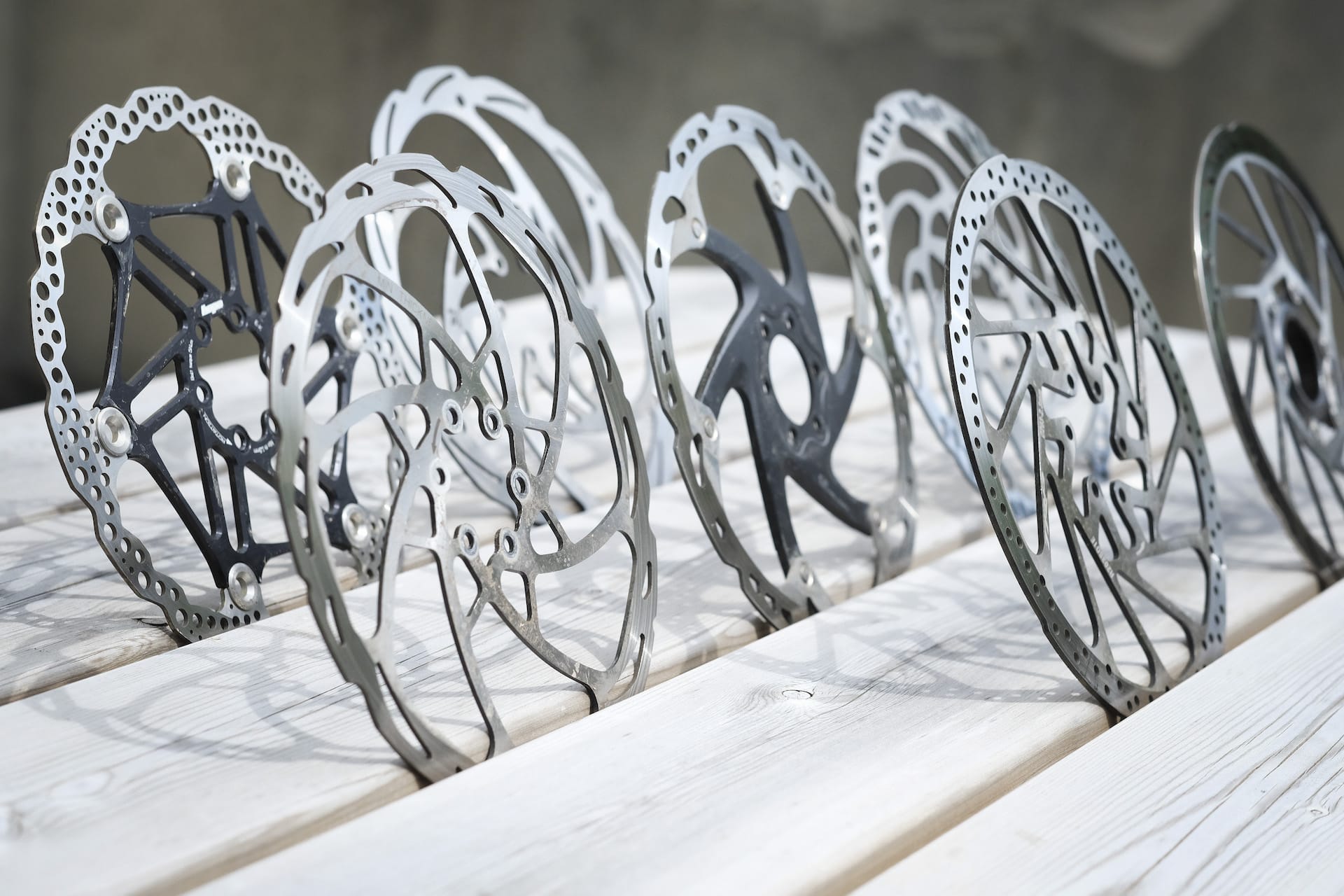
Why should you go for 4-pot brakes? I’d ‘answer’ that by flipping the question on its head. Why wouldn’t you go for 4-pot brakes? The only supposed negative to 4-pot brakes is that they weigh more. Which is hardly a negative at all in my book. Performance trumps all. And the thing that you will find when using powerful brakes is that you very quickly recoup that handful of extra grams by sheer virtue of using less of your body’s energy.
Once you ride with really strong brakes for a bit and then go back to a mediocre set, you instantly realise just how much energy you expend in both the physical act of braking and the attendant all-over body tensing that goes with weedy brakes. With powerful brakes, you use them less, your whole body de-tensions (forearms most immediately, but the knock-on effect reaches every part of you). You relax. You breathe better. Your bike rides better. You ride better. You get better at riding. You have more fun. It’s a totally virtuous circle.
To chuck that out of the window to save 75g (if that)? Bananas.
There is no such thing as a brake that is too powerful, so long as it has control. But, without wishing to cloud the waters any further, there is an argument that once brakes meet a certain level of power, it is control/feel/modulation that is the real quality best worth chasing.

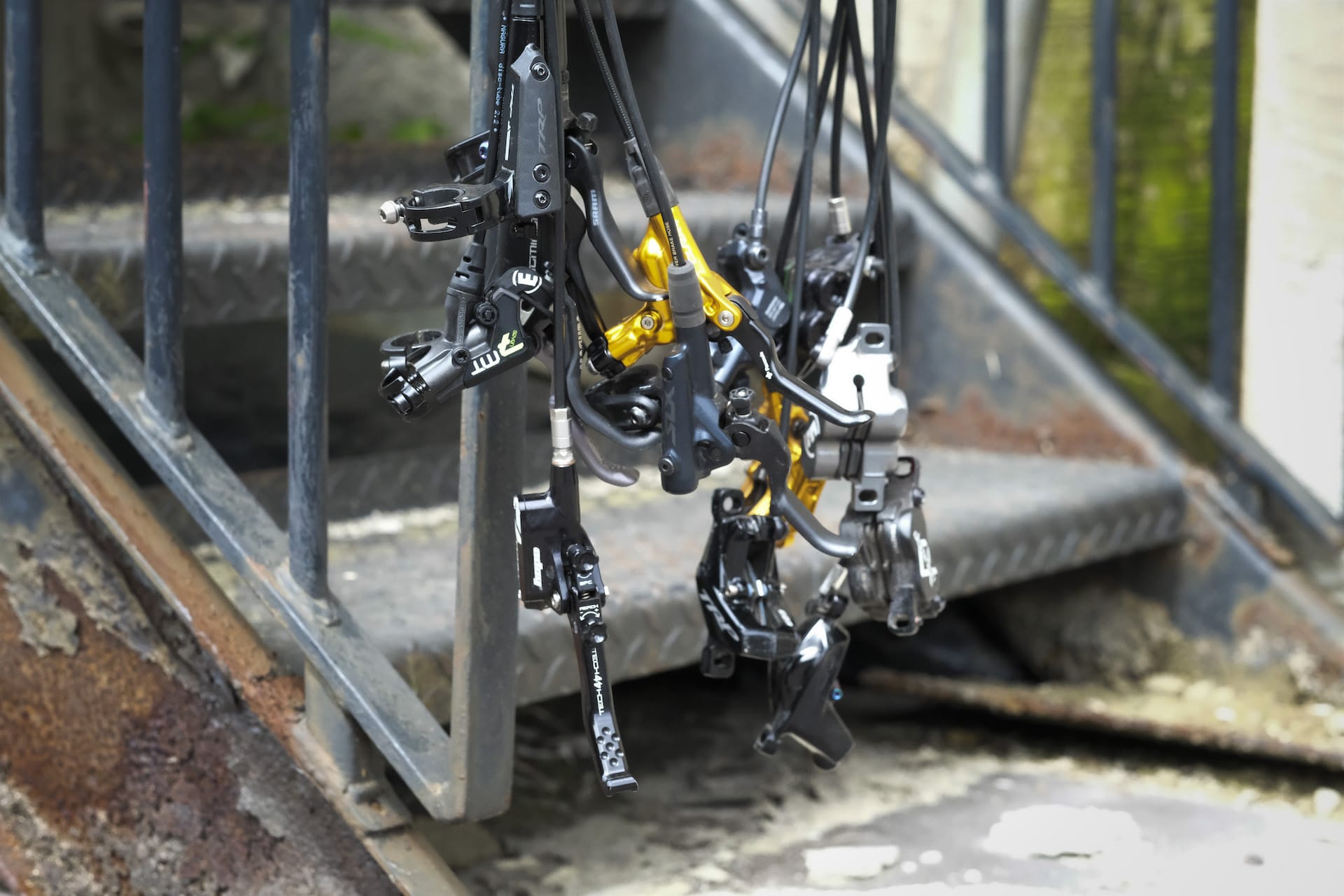

What to look for in a 4-pot disc brake?
Don’t avoid big rotors. It’s tempting to think something along the lines of ‘well, with 4-pot caliper brakes I can probably get away with a 180/160 rotor combo’. Nope. No you can’t. Big rotors are great. Ignore any naysayers who complain that they are OTT or too grabby. They aren’t. Not if you readjust your fingers. Stop operating 4-pot brakes with 203mm rotors as if they are 2-pot brakes with 180mm rotors. The beauty of big pots and big discs is the lightness of touch they require. And yeah, maybe even go 203/203 to help even up the feel. The whole bigger rotor on the front theory is just that. A theory. And I don’t really hold with it, personally.
Don’t skimp on pads. You know how you hear people say that they’d rather ride a cheap bike with expensive tyres than vice versa? It’s the same for disc brakes. Put a ropey set of eBay pads in a megabucks disc brake and it will be rubbish. Invest in decent pads. Or don’t bother getting good brakes at all. Budget pads in budget brakes I can kinda agree with. Rolls Royce brakes with Reliant Robin pads? Waste of time.
Speaking about pads. Bed them in. Same goes for new rotors. No one (not even me) wants to do this. But I do it. Because I have felt the difference.
Get a bleed kit and learn how to use it.
Double-check what (if any) extra Matchmaker-style clamp you need to go with your shifter before removing your previous brakes or setting up a new bike build. It’s annoying to get near the end of the procedure and realise you haven’t got a way of attaching your shifter to the bar any more!
Things not to be bothered about: fluid type and rotor thickness. Sure, we could have a heated debate about these things, but in my experience neither have much of a consistent bearing on performance. You get good DOT brakes with thick rotors and you get equally good mineral oil brakes with thinner rotors.
I’d also be a bit meh about bite point adjustment. I never seem to use it, or set it anywhere other than ‘bite as soon as poss please’. But on a related note, make sure your brake lever can be adjusted to lie where you want it to. Some brakes can’t be winched in near enough for some riders.
Formula Cura 4
- Price: £175.00
- Rotor weight: 199g (203mm)
- Brake weight (per end): 245g
- Tested by: Benji

Overall: No bells. No whistles. Just feel and modulation for days. And more than powerful enough.
Read the full review of the Formula Cura 4
Hayes Dominion A4
- Price: £199.00
- Rotor weight: 176g (203mm)
- Brake weight: 287g
- Tested by: Benji

Overall: The ‘features’ are arguably red herrings, but this is a great brake for those not enamoured with modern mega-levers.
Read the full review of the Hayes Dominion A4
Hope Tech 4 E4
- Price: £175.00
- Rotor weight: 174g (203mm)
- Brake weight: 272g
- Tested by: Rhys
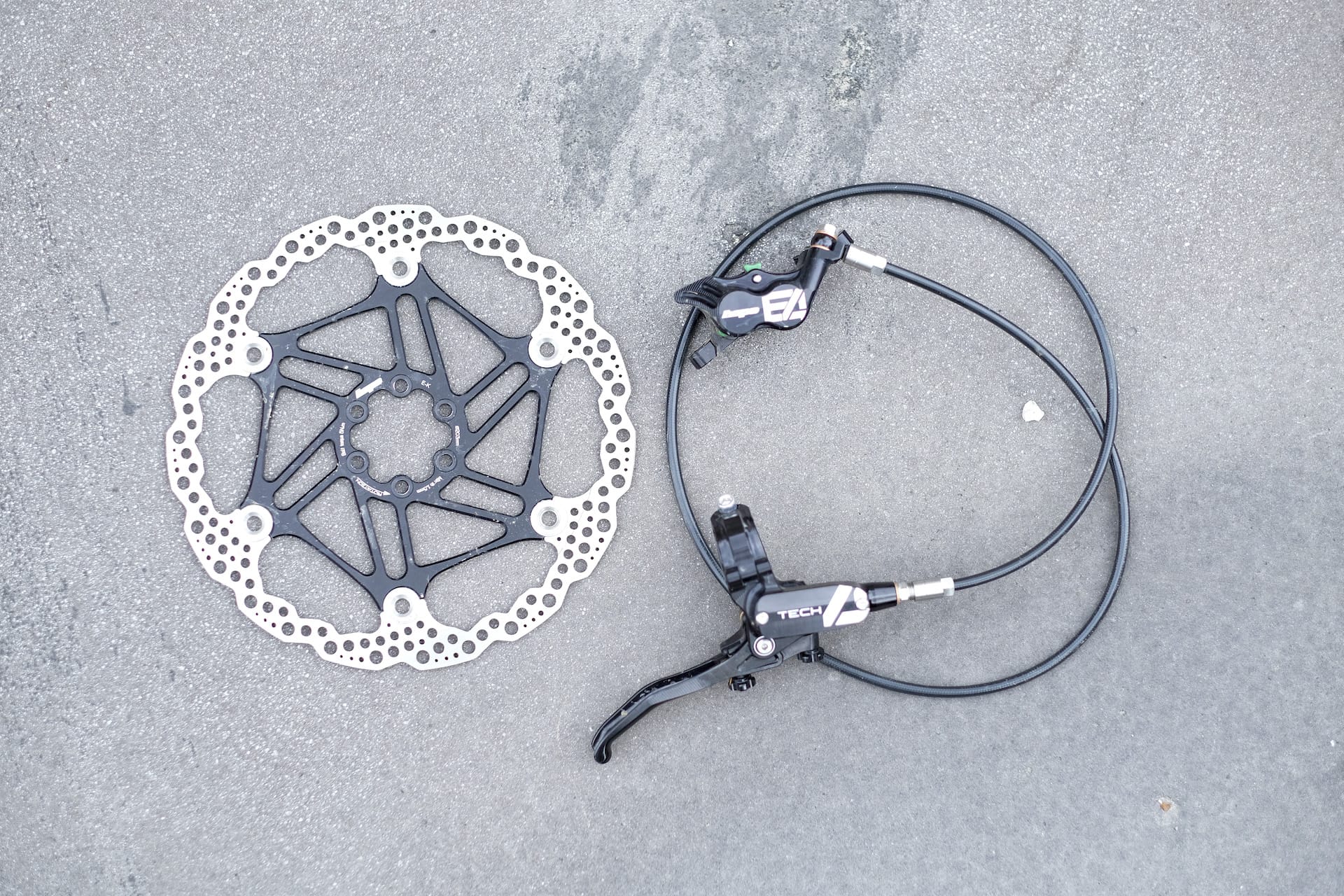
Overall: Performance has been excellent. When I sling the Barnoldswick anchors out before the next corner I’ve a big ‘confident-I-can-stop’ grin on my face.
Read the full review of the Hope Tech 4 E4
Magura MT7 Pro
- Price: £190.00
- Rotor weight: 223g (203mm)
- Brake weight: 248g
- Tested by: Benji

Overall: Definitely on the grabbier side of the spectrum and the lever shape can be polarising, but I love ’em.
Read the full review of the Magura MT7 Pro
Shimano SLX M7120
- Price: £175.00
- Rotor weight: 168g (203mm)
- Brake weight: 286g
- Tested by: Benji
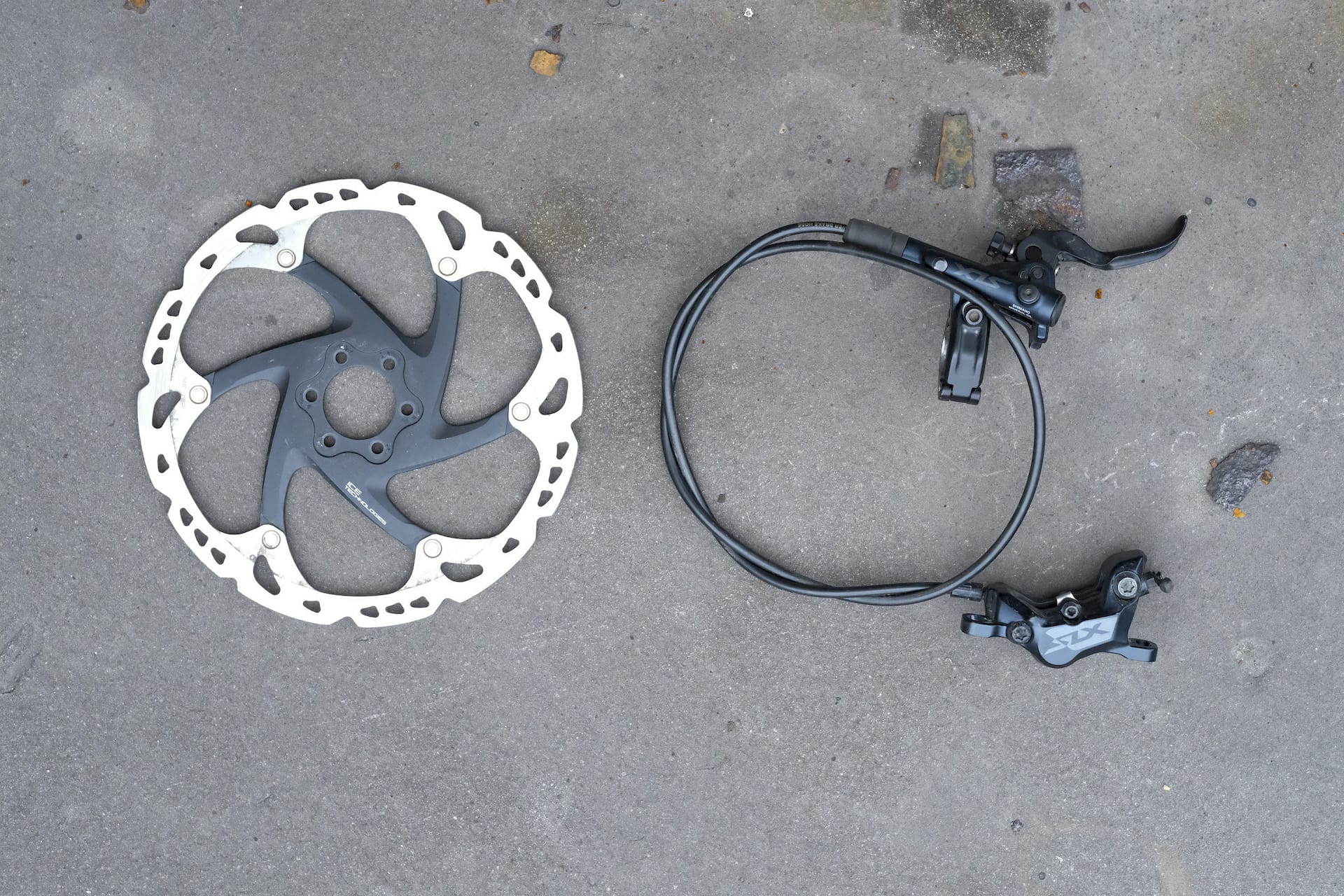
Overall: Not fit and forget, but you know what? If you like working on your bike anyway, there’s nothing like a Shimano stopper.
Read the full review of the Shimano SLX M7120
SRAM Code RSC
- Price: £230.00
- Rotor weight: 250g (200mm)
- Brake weight: 314g
- Tested by: Ross

Overall: Not just power anchors. Their best feature is how well you can control that power.
Read the full review of the SRAM Code RSC
TRP Trail Evo
- Price: £180.00
- Rotor weight: 242g (203mm)
- Brake weight: 309g
- Tested by: Benji

Overall: A well-made, consistent brake that frustrates with a far-out bite point. Great for those with truly massive hands!
Read the full review of the TRP Trail Evo
The verdict

We’d happily have any of these brakes. Which is something of a cop-out isn’t it? But it’s true. They are all really, really good brakes. So if you were to see a particularly compelling deal on any of them, go for it. But seeing as this is a comparison test, let’s do some comparing. After all, there are some riders who like their brakes to behave in very particular ways and they ain’t interested in anything else thankyouverymuch.
For all-out power freaks, we’re going to give the nod to the SRAM Code RSC. It has just about the most anchor-dropping chops of all these brakes here. The brake with the most feel and modulation was the Formula Cura 4. Not everyone liked the rounded lever shape, but there was no denying the control that these offered.
Perhaps frustratingly, the brake that felt like the best combination of top-end power and all-over feel was the Shimano SLX M7120. Why frustratingly? Because they aren’t fit and forget brakes. You need to keep an eye on the pad wear level and do super-conscientious bleeds.
Folk who like to run their bite points really close to the grip should give the Magura MT7 Pro brake a try. The overall feel of them is actually very close to a fully functioning Shimano brake too, perhaps just not quite as top-end powerful.
And finally, something of a niche and/or outlier. The TRP Trail Evo has a super-light lever action and impressively short throw before bite point. Great for racers. If you can handle (literally) having the levers set relatively far away that is.
If we absolutely, positively have to nail our colours to the mast and pick The Best Brake we’d go for the… Formula Cura 4. It just goes to show that neither lever shape nor ultimate power levels are anywhere near important enough to trump modulation and control. The lever shape was no one’s favourite, but it was OK. They weren’t the absolute strongest brake but they were certainly powerful enough. The key thing was that the Formulas had the feel. And that’s what ultimately counts.
Story tags

