UPDATE: Reviews section refreshed, redesigned, searchable: Go take a look
So there's the familiar problem that has been around for quite a while now, but personally, I have never been able to get my head around WHY the answer is the case. I've seen it written out long ways, short ways, with demonstrations and thought experiments, but never have I been able to bend my mind to accept it.
Problem (in this version, from Wired magazine):
Suppose you're on a game show and you're given the choice of three doors: Behind one door is a car; behind the others, goats. You pick a door, say Number 1. The host, who knows what's behind all the doors, opens another; say Number 3, which he knows is hiding a goat. He then asks, "Do you want to pick door Number 2?" Is it to your advantage to switch your choice?
Answer:
Yes. Switching your choice always raises your odds. Originally you had a 1 in 3 chance of guessing the correct door. When Monty shows you the goat behind a door you didn't choose, the probability of a car being behind that door drops to zero and the chance that there's a car behind the third door thus rises to 2 in 3. So your odds improve if you switch your choice.
Now, here is where I can't follow it. Why are the odds after the door has been opened not 1 in 2?
The way I see it, when you are offered the swap, you are effectively given the choice to choose again, between the two remaining doors, which makes it 1 in 2 (surely?). If you choose the same door again, it is the same [i]effect[/i] as sticking with the original 1 in 3 odds, but with updated information - making it a 1 in 2. The third door is now irrelevant, which suggests to me that [i]'the chance that there's a car behind the third door thus rises to 2 in 3.'[/i] is bunkem.
Anyone care to have a go at explaining it?
hmmm
The easiest way is just to play it out. Consider three doors, A, B and C. A and B have sheep behind, C has the car.
Scenario 1. You pick A. Monty reveals B. To win you need to change to C
Scenario 2. You pick B. Monty reveals A. To win you need to change to C.
Scenario 3. You pick C. Monty reveals A or B. To win you need to stay with C.
So, in 2/3 of the scenarios you win by changing, and in 1/3 you win by staying.
It's because you could still in theory pick the door he's already opened. Which is daft. So it's still a three door problem even though it's not.
r0bh - MemberThe easiest way is just to play it out. Consider three doors, A, B and C. A and B have sheep behind, C has the car.
Scenario 1. You pick A. Monty reveals B. To win you need to change to C
Scenario 2. You pick B. Monty reveals A. To win you need to change to C.
Scenario 3. You pick C. Monty reveals A or B. To win you need to stay with C.So, in 2/3 of the scenarios you win by changing, and in 1/3 you win by staying.
you have actually compressed 2 separate scenarios into option 3, so thats a flawed argument.
Why are the odds after the door has been opened not 1 in 2?
Now you can get into some probability but I find it easier to take a slightly different look at the problem.
You choose one door.
The host then offers you a choice, keep the single door you chose or take [i]both[/i] of the other doors.
Think about what the probabilities are now.
This is essentially the same choice as previous as you [i]know[/i] that one of the doors in pair must include a goat so by showing you this the overall probabilities don't change. Remember probabilities can only change with new information. Dressing up old information as new doesn't count.
[s]r0bh's explanation is excellent; it answers why it is 2 in 3, and I can follow that through and accept that, but it doesn't disprove the 1 in 2 idea in my mind (which obviously can't be ALSO correct if I accept the 2 in 3)[/s] Edit - ok maybe it doesn't...
For years I've had to accept I don't understand it, and that to accept the 2 in 3 fully I'd have to effectively put faith in the 'experts' without being able to prove it to myself - and I can't do that 👿
you have actually compressed 2 separate scenarios into option 3, so thats a flawed argument.
No it's not. The scenarios are only dependent on what door you pick first. Three scenarios for three doors. In scenario 3 the door Monty chooses to reveal is irrelevant.
Militant_biker - MemberNow, here is where I can't follow it. Why are the odds after the door has been opened not 1 in 2?
They are. All the rest is just the awesome ability of statistics to prove something that isn't true.
It's also to do with which door the host opens and where the car is.
[img] 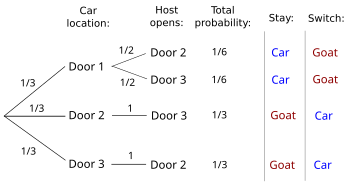 [/img]
If you look at this on wiki its a nightmare of odd symbols and expensive looking maths.
Seems that once the door is open you now have a 50/50 choice on what's left. I'll be dipped in dogshit if I can fathom why it's 2/3, seems to include the open door but you know that's out so I don't get it.
Now my brain's hurting.
Raises eyebrow at Northwind... Do you mean the accepted answer or the 'answer' I quoted?
Think of it this way...
You pick one of the three doors.
The odds that you picked the right one are 1 in 3.
The host opens a door and shows you a goat.
At this point, before offering you a choice, would you agree that the odds that you picked the right door are still 1 in 3?
By the host opening the door, we know that the odds of there being a car behind that door have collapsed to 0, while the odds that you picked the correct door to start with is still 1 in 3, you haven't been asked if you want to change yet.
As the set of all odds has to add up to 1, the other door then must have odds of 2 in 3 that the car is behind it.
Still no choice been allowed here.
At this point you are asked if you want to change. Can you explain to me why the odds would then change to 1 in 2 at this point?
never mind all the maths - has any one ever found out empirically what choice is the best one?
.
Pathetic voice don't know why the did that but this help explains it.
Last time this came up someone, GrahamS I think, wrote a script for testing this and proved it empirically. It's also been done in Excel as well I believe.
The answer is to always swap.
I can't be bothered to read all the replies, but it did take me a little while to understand the first time around. It makes sense to me like so:
At the beginning, the chance of picking the right door is 1/3. You pick your door. The chance that the car is behind one of the other doors is 2/3. Ignore the host. Whatever he does, since there is no way he'll pick the car, the odds don't change. Your door is still 1/3 and the doors you didn't pick are still 2/3.
It's just that the other doorS are now just one door.
funkynick - I'm with you up until
No, once the door has been opened, the odds are no longer 1 in 3. The odds WERE 1 in 3, but once the door is opened the odds of the door STILL being correct are now 1 in 2.At this point, before offering you a choice, would you agree that the odds that you picked the right door are still 1 in 3?
When asked if you want to change, I view it like this. The opened (or third) door is irrelevant. You have 2 doors in front of you. One contains a goat, or contains a car. You again choose at random (which is 1 in 2). Now half of the time you would choose that same door (which is sticking) and half the time you would choose the other door (which is switching). That's my logic behind the odds changing to 1 in 2.At this point you are asked if you want to change. Can you explain to me why the odds would then change to 1 in 2 at this point?
Empirically - the solution is correct, switching is successful in 2 in 3 cases. And I'm almost happy with that, but I'd love to know why!
How about this... if there are 100 doors, 99 goats, one car...
Pick a door, the odds on the car are 1 in 100
Now he opens 98 other doors with goats behind.
Do you contest that at this point, without any other choise being offered, they you have a 50:50 chance of winning the car?
Milliant you need to think back to the start, you had a 33% chance of picking a car and 66% picking a goat.
The hose opens the door and you stick means you still have that 33% chance of picking the car as you didn't change anything.
You decide to swap that means you now have increased your odds to 66% chance but only if you picked a goat first but you had a 66% chance to do that.
but once the door is opened the odds of the door STILL being correct are now 1 in 2.
Why? What new information do you have about the door that you chose?
The opened (or third) door is irrelevant
No it's not, as you knew as soon as you chose one door that one of the other two MUST have a goat.
When Monty shows you the goat behind a door you didn't choose, the probability of a car being behind that door drops to zero
That bit it is wrong though it can't be zero unless there was no car, it's 33%.
Arse I misread that.
Consider three doors, A, B and C. A and B have sheep behind, C has the car.
Scenario 1. You pick A. Monty reveals B. To win you need to change to C
Scenario 2. You pick B. Monty reveals A. To win you need to change to C.
Scenario 3. You pick C. Monty reveals A. To win you need to stay with C.
Scenario 4. You pick C. Monty reveals B. To win you need to stay with C.
There are 3 doors, but 4 possible scenarios, its just a logic trick.
Drac.. no it's not, you know for certain that there is no car behind that door as you can see a goat behind it, therefore the probability of it being the car is 0.
Wot funkynick said.
Extrapolate the number of doors upwards and it's then obvious that you should choose again.
funkynick [i]Do you contest that at this point, without any other choise being offered, they you have a 50:50 chance of winning the car?[/i]
I would say that, intuitively, it's a 50:50 chance, because there are only 2 doors left. I fail to see how the other 98 doors (or 1 door) can have any bearing on the choice. I see it as having ANOTHER choice based on the 2 doors, which points to 50:50.
drac. I don't accept that you [u]stil[/u]l have that 33% chance. Thats my problem!
In all of this, I know empirically that I'm wrong, I'd just love to be able to convince myself of the right answer!
It's very similar to something called 'The principle of restricted choice' in Bridge. [Missing two equivalent cards such as the J and Q, if one opponent shows the Q, say, on trick 1, then the odds now favour them not having the J and you should play the other opponent for it.] Sort of meaningless if you don't play Bridge I guess, but the point is it's a proven principle that's used to determine strategy in the game.never mind all the maths - has any one ever found out empirically what choice is the best one
If you google 'principle of restricted choice' there's all sorts of similarly impenetrable proofs out there as for the Monty Hall problem
MSP... You are correct that there are 4 possible scenarios, but scenarios 3 and 4 have only half the probability of 1 and 2.
See Drac piccie earlier in the thread.
gonefishin - [i]Why? What new information do you have about the door that you chose?[/i]
I have no new information about the door I chose, but I now know that the door that was opened is a goat (and can be discarded?)
My logic means I flush the cache on what I used to know. I can see 2 doors closed, one of them I know holds a goat, one of them I know holds a car.
My problem is not in accepting the 2 in 3, which can be proven, it is in disproving the 1 in 2 theory. It obviously cannot be both.
The only way I can tell myself it's not 1 in 2, is the fact that it's 2 in 3 - ARGH!
It's not 1 in 2 as there's still 3 doors but you know the answer to one so your not going to pick that which increases you odds to 2/3 as you it's like getting a chance to go again.
The whole point of this puzzle is that it's supposed to highlight that our intuition is wrong (similar to the puzzle someone posted a couple of weeks back).
On the first choice you have a one in three chance of making a correct choice, and a two in three chance of goating out.
When the host asks if you want to change your mind, what's essentially happening is that you're being offered to swap the one door you have for [i]both of the other doors.[/i]
You both know one of the remaining two doors contains a goat, by opening a door (with his insider knowledge) the host simply confirms something you knew anyway. Changing your mind nets you both doors, the opening of one of them is a bit of very effective misdirection.
[i]You both know one of the remaining two doors contains a goat, by opening a door (with his insider knowledge) the host simply confirms something you knew anyway. [u]Changing your mind nets you both doors, the opening of one of them is a bit of very effective misdirection.[/u][/i]
Ah ha... this begins to make a little more sense.
Say you choose door 1, and supposing the host gives you the opportunity to keep the contents of door 1, or to swap and keep the contents of BOTH other doors. Obviously you'd swap, because that gives you a 2/3 chance of winning. The host then says I'll save you the bother of opening both doors, I'll open one of the doors for you.
The only difference in the actual game is that the host opens one of the doors before asking if you want to swap instead of after, but that's irrelevant.
the [u]only[/u] way to switch and LOSE, is if you picked the correct door first time (probility 1/3)
If switch-and-lose is 1/3 then switch-and-win must be 2/3
I can see 2 doors closed, one of them I know holds a goat, one of them I know holds a car.
Just because there are two outcomes doesn't mean that the probabilities are equal. For example there are two outcomes with a lottery ticket, it will either win the jackpot or it won't, but the odds aren't 50:50
For example there are two outcomes with a lottery ticket, it will either win the jackpot or it won't, but the odds aren't 50:50
Ah! I get this!
sas - your explanation works for me too
Thanks!
Reading this thread was worth my time just for the phrase 'goating out'
I liked the 'goating out' too 🙂
(-:
Sounds a lot worse than it is, doesn't it. I may have to see if I can slot it discreetly into unrelated conversation at some point. Maybe my next team meeting.
On your first choice you are much more likely to pick a goat. Therefore conclude that you have. So when they show where the other goat is, it's much more likely that the car is behind the remaining unopened door.
Easy!
What I don't understand is this: in the last episode of Star Trek Voyager, which I only watched last week, Voyager is heading towards the exit of the transwarp hub but is being chased by a Borg sphere. Voyager's shields are down and Tuvok says 'the only exit is back the way we came'. Cut to next scene, the sphere exits the hub near earth and is blown up by other starships, and [u]after[/u] that out comes Voyager! WTF?
If this were a real life situation tried 99 times, are you telling me that if I stick I'll win on average 33 time and if I change I'll win 66 times? I'll bet on average it'll be 50 50.
If this were a real life situation tried 99 times, are you telling me that if I stick I'll win on average 33 time and if I change I'll win 66 times? I'll bet on average it'll be 50 50.
Try it. Just get like two 10p coins and one 20p, and see what happens. Do it 10 or 20 times. I did it 10 times, and got the 20p 6 times, and the 10p 4 times, changing every time. Not very conclusive of course, its one time off 5/5, would be better to repeat it.
Also doing it for yourself makes it so obvious. You realise if you decide to change before you begin, you just have to pick up a 10p to win the 20p. You have a 2/3 chance of picking up a 10p. If you choose not to change before you play, you have to pick up the 20p, of which you have a 1/3 chance of winning it.

