UPDATE: Reviews section refreshed, redesigned, searchable: Go take a look
Unfortunately my male [i]Chilobrachys[/i] sp Aladdin has died. He has spent several months looking for a mate but has now died a natural death.
[img] 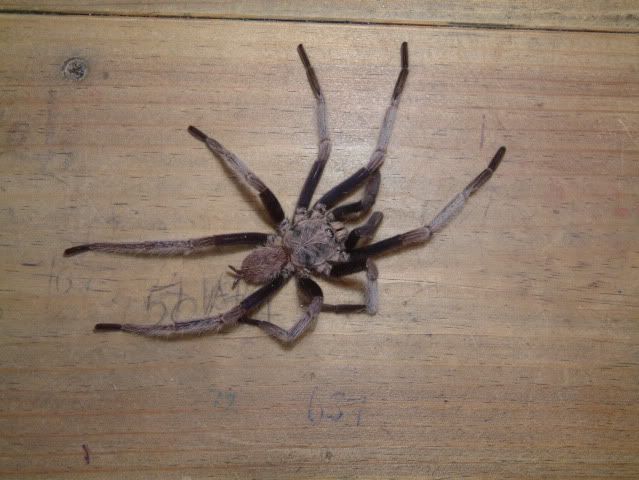 ?t=1295622812[/img]
Once matured, male tarantulas don’t moult again and instead die of old age. I would liked to have mated him (careful now) but was unable to find a suitable female in time.:(
Still it gives me a chance to show off a lovely spider which has hardly ever been seen (in the wild or captive) and explain a little spider taxonomy :)(though I should point out I am not an expert in any way) Still I won't let that get in the way.
So, [i]Chilobrachys sp[/i] Aladdin, Mature Male
[img] 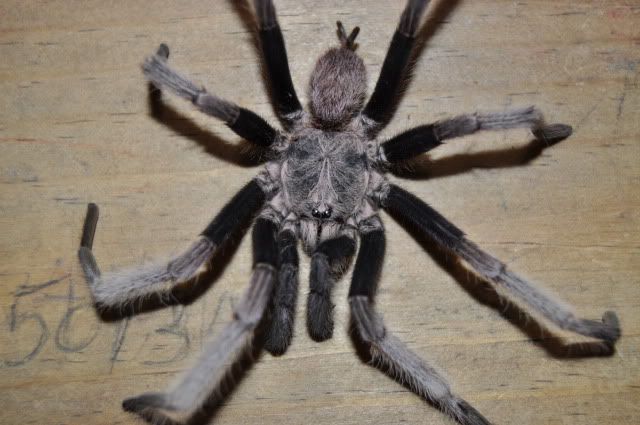 ?t=1295622908[/img]
These are very rare, they have been known for about 10 years or less(I can’t remember atm) and have do not yet have an official name, which is why they have “sp Aladdin” rather than just “Aladdin”in their name. These are native to Thailand and are old world shy spiders, which web a lot.
Some tarantula males can be fairly easy to sex, this one has very long lanky legs but the main give-away are his “boxing gloves”,I will try and explain.
All spider have 8 legs, numbered l-lV on the left and l-lV on the right. The rear leg being lV.
You may have noticed there actually appear to be 5 legs either side, two short ones at the front called pedipalps. These are not legs (they lack the metatarsus) but are used more like arm/legg things. Mature males will have boxing gloves at the end of his palps, these are called cymbium. Cymbium contain a hook called the embolus.
[img] 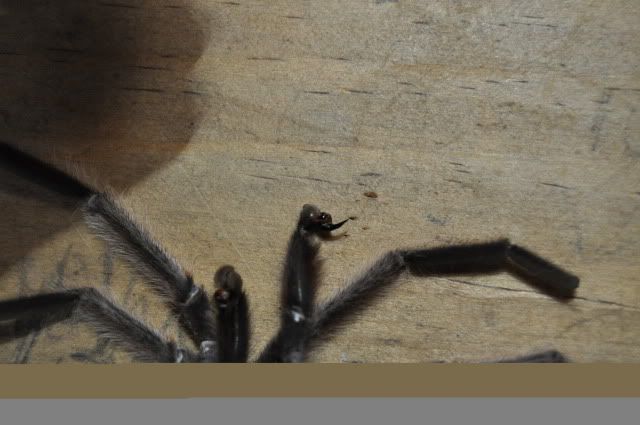 ?t=1295623045[/img]
The male will use these hooks transfer his sperm to a female during mating.
seen here using a USB miscroscope
[img] 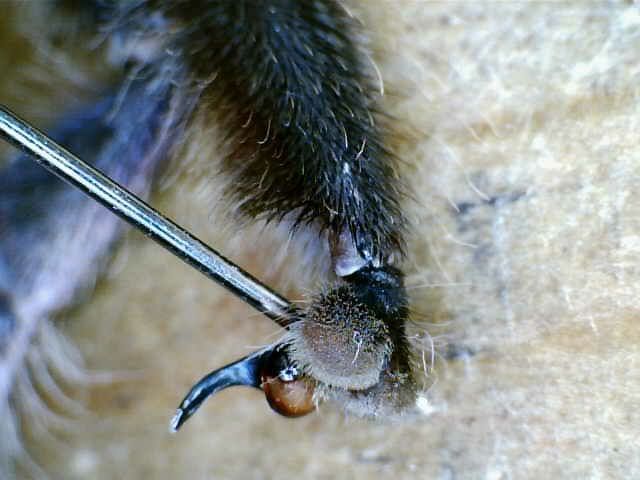 ?t=1295623125[/img]
Also all tarantulas have 8 eyes, which are separated into 2 rows, anterior row and posterior row. These can sometimes be difficult to see so I’ve taken a closer shot.
[img] 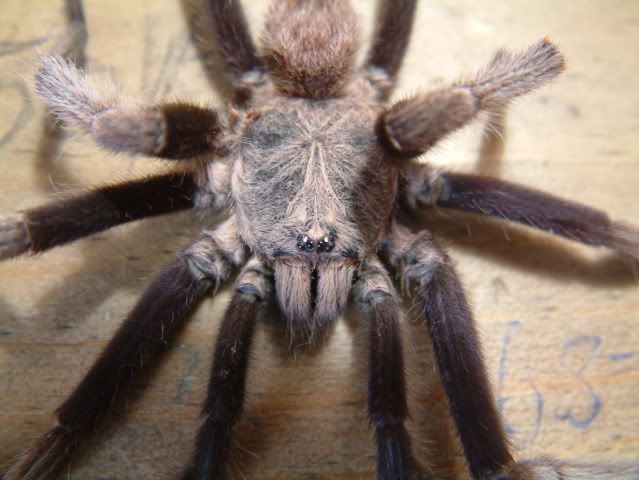 ?t=1295623209[/img]
The eyes are called ocular tubercle or eye turrets and are normally set out in the same pattern, depending slightly on the species. The eyes on the outside of the turret are known as lateral eyes and those on the inside are median eyes. So this gives us anterior lateral eyes (ALE), anterior median eyes (AME), posterior lateral eyes (PLE) and posterior median eyes (PME)
[img] 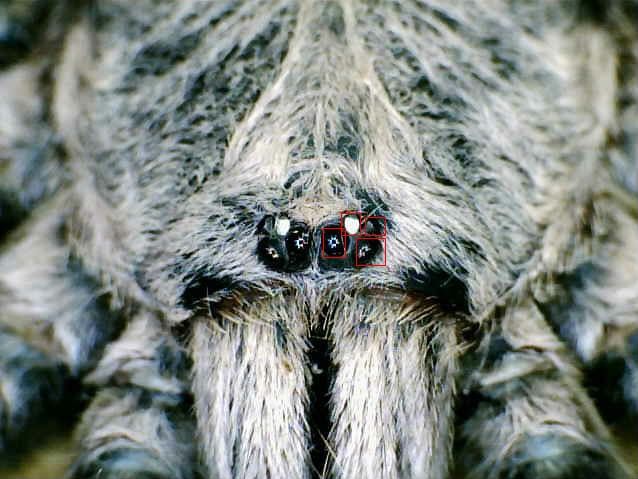 ?t=1295624143[/img]
Bottom left AME
Bottom right ALE
Top left PME
Top right PLE
and lastley a few more shots of the old fella when he was doing what he did best 🙁
[img] 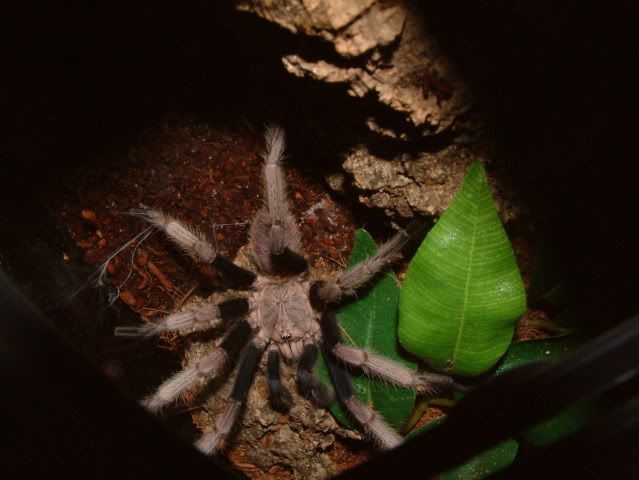 ?t=1295623293[/img]
[img] 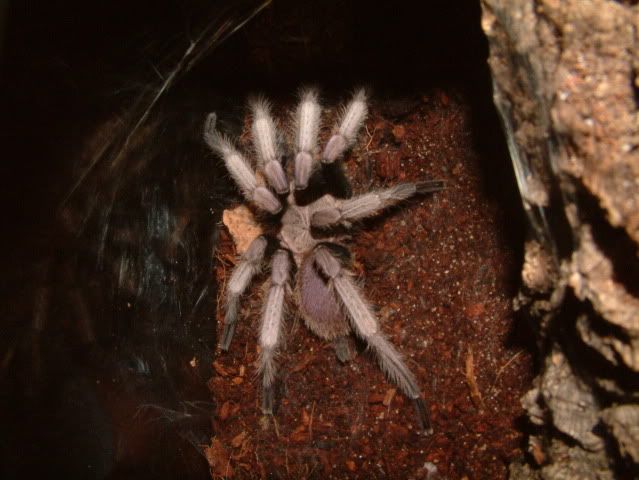 ?t=1295623370[/img]
(well I did say he was shy).
Never a dull moment on a Roper thread! 😀
Great stuff
RIP Aladdin 😐
Poor ****er didn't even get a shag..............died a virgin 🙁
That wasn't dull at all!! Thanks for sharing. Still hate 'em tho....
very interesting, i have a fear of spiders, but love to read about them, etc i guess its a case of understanding what you fear or something like that, excellent stuff anyway thanks
I am on one hand elated for another Roper thread, but on the other sad for Aladdin. Poor chap.
Sad news but an interesting read....enjoyed that. Can't think of anything else I'd rather be doing on a Friday night than reading about dead spiders 😉
I don't get spiders, they completely freak me out and give me the creeps. If there is one in my house I boot them out inside the nearest glass I can find and think they are the stuff of nightmares but that thing up there is pretty cool.
So when you say
He has spent several months looking for a mate but has now died a natural death.
Did he die because he couldn't mate? Genuine ignorance? Was it broken heart 🙁
And is that spiky bit his willy!? Ouch poor girl spiders?? 😳
Ouch poor girl spiders??
Well least they don't get eaten after making passionate love 😐
Although I'm guessing that the sperm is deposited manually.
Eh? Eaten!? Ok 😕
Well I don't know about [i]Chilobrachys sp Aladdin[/i], but irrc plenty of species do.
Ewwwww, I thought that was just grasshoppers but whatever floats yer boat I suppose.
but whatever floats yer boat I suppose
😕 Whatever floats my boat ? ..........I didn't say I did it !
http://www.msnbc.msn.com/id/26661502/ns/technology_and_science-science/
I didn't necessarily mean your boat ernie, more the spiders 🙂
Edit: haha - so according to that article size really does matter then? 😉 funny
Spiders on a boat?
Get me Hollywood on the phone!
He has spent several months looking for a mate
As a male spider in captivity, where exactly do you go looking for a mate? Do you put on spider speed dating for him?
Do you put on spider speed dating for him?
Nah, he just looks on the web.
Hahahahahahahahaha Jamie that made me lol
Me too 😀
All males stop moulting once they reach maturity. How long they live will depend on the species and a few other conditions. Females can continue to moult and so can live considerable longer than males. With the classic tarantula like the [i]B.smithi[/i]
[img]  ?t=1295692285[/img]
A male will reach maturity at 8 to 10 years or so and may live from 10,12 up to 15 years. Females can live 35,40+ years as they continue to moult.
As a male spider in captivity, where exactly do you go looking for a mate? Do you put on spider speed dating for him?
lol, Not that far off. Normally I would advertise on the internet for a suitable mate, or through friends. The standard deal of 50/50 or there abouts with any slings. Unfortunately as these are so rare there were fewer options for him. There were a couple of possibilities from one of the people who discovered them in Thailand. He has some juveniles were hoping to sex with the hope one would be female and a suitable mate for my male. The [i]Chilobrachys [/i] male to female ratio is not very good and his juveniles all matured to be males.
I do have three [i]Chilobrachys sp Aladdin[/i] spiderlings from one of his cousins which are all growing very well. Hopefully once they mature I will be able to track down a few mates.
Years back I had a male brachypelma smithi who once I'd got him sadly only moulted once before he matured. Tried unsuccesfully to mate him. When he croaked I filled his abdomen with bathroom silicon sealant and mounted him in a clear box, labelled with his latin name, sex and date! Mum wasn't too chuffed and threw him out when my guard was down because "he smelt" 👿 RIP Claudius
Great thread 😀
I don't like spiders much...
...but this thread is very informative.
Nice!
Now that was interesting
*Currently standing on a chair and itching all over* 😳
I think Roper's spiders and creepy-crawlie threads are brill, and should replace the A+A threads which have got boring anyway.
So, instead of Friday Kylie, we could have a 'Friday Spidey' thread! 😀
really interesting, my 7yr old daughter saw me looking at the pics and insisted that i read it all out to her.
I'm pleased I didn't get too geeky.:)
Though it does happen as many of my friends will admit.
izakimak
There are lots of amazing spider and bugs in the UK too. Just about all can't bite humans.
You can get a good jewelers loup for under £10
[url] http://www.amazon.co.uk/powered-Magnifier-Jewelers-Dictionary-reading/dp/B0034BNADG/ref=sr_1_3?ie=UTF8&qid=1295717921&sr=8-3 [/url]
or one of these.
[url] http://www.amazon.co.uk/Tobar-8020-Bug-Box/dp/B000H6UQA6/ref=sr_1_1?ie=UTF8&qid=1295718270&sr=8-1-catcorr [/url]
They are great for entering the spiders world and seeing what they are up too.
Another roper smasher! Cheers. These brighten up my weekend.
Feel sorry for those spideys in Thailand though - what a crap ratio - it's like living in Qatar! 😀 (if you're a bloke)
Oh and this bit from the thread title:
(warning it gets a bit boring)
is utter bollocks. They never get boring mate. Thanks again.
Interesting thread, thanks for taking the time to post this up.
Do you do this as a hobby or for work?
An observation Roper: you don't come as sentimental about the beasties, just fascinated. For example: if my cat died, I would grieve to extent. Do you feel anything like about the loss of the tarantula? I'm not having a pop, honest! I'm just curious to better understand your motivation to keep these usual pets. Can you explain? 🙂
My bug collection is a hobby ( I’m not an arachnologist) but it does overlap a little sometimes.
My spiders and bugs are kept in as much a natural environment as possible. I hardly ever handle them and try to observe them in their natural behaviour (as much as possible with captive wild animals). I do find them fascinating to watch and learn about as they really are amazing creatures, have been around so long you can study them along with the history of the earth, but so little is still understood about them.
Tarantulas are struggling in numbers in the wild and any new information learnt about them could have important benefits in their survival. Even though he will be missed and was one of my favourites. Saying that, when I’m away I do worry about them and do fuss over them most days.
Also I only actually see one of two species few times a year, as they are naturally fossorial. I suppose it could be difficult to become emotionally attached to something you don’t really see. Though I do still care for them as well as the species which are always active and on display.
Keeping bugs like spiders is often compared to keeping other animals like fish. You watch and learn but don’t really touch, it doesn’t benefit the animal or us.
I would encourage anyone to have a closer look though. Understanding bugs is understanding our environment and can be very easily done for relatively small amounts of money or time. It can also be very rewarding seeing them moult, hunt, re-arrange their enclosure, mate and develop, all from the comfort from your (spider) room. Each tank a little snippet of something happening in all sorts of areas around the world.
Cool 😀
Have to admit that I'm another one who gets a 'strange itchy feeling and...oh...my...god...what's THAT crawling up my BAAAAAACK!' whilst reading these threads. But I do like them. It's interesting to see what other people know about and are prepared to share, so, thanks Roper!
Well least they don't get eaten after making passionate love
...
Ewwwww, I thought that was just grasshoppers but whatever floats yer boat I suppose.
I thought some girls liked that 😕
really interesting, my 7yr old daughter saw me looking at the pics and insisted that i read it all out to her.
I shall have to see what my 4yo son makes of the pics!
As others have said, what a great thread - anything but boring (and such a refreshing change from all the usual rubbish on here - this is what makes the STW forum great, not the freedom to swear!)
Fossorial - I had to look that up.
"A fossorial organism is one that is adapted to digging and life underground"
great thread again Roper.
Roper. I have been reading a few of your old threads in equal measure of awe and fear. I notice you talk about old world and new world spiders and also real/pure spiders any chance on a lesson between the differences as I have no idea.
TIA
Hello I_Ache, I'll try and explain but the scientific category of Araneae or arachnid is quite a complex muddle especially as there are scientific names and common names used.
There are thousands of different types of spiders and so groups which share certain characterises are classed together, and them sub families of these until we get each description.
Tarantulas are Theraphosidae. There are a little over 900 species of Theraphosidae known but it has been estimated there could be 2000 or more over all.
There are a few basic categories used to identify some variants of Theraphosidae such as new world, old word, fossorial, terrestrial or arboreal.
New World tarantulas all have a few defence characteristics in common. If threatened they will run or hide. If that doesn't work they can flick urticating hairs at the attacker. If that doesn't work they can bite.* Urticating hairs are most commonly found on the bum (opisthosoma) of the spider and they flick the hairs with their back legs. (Though some sp have urticating hairs near their fangs too).
Old world tarantulas don't have urticating hairs so either run or hide,make a hissing sound, if threatened, or bite.
Fossorial-mainly live underground
Terrestrial mainly live on the ground
Arboreal Mainly live in trees.
*It has recently been discovered that some Theraphosidae shoot poo or release a obnoctiouse odour, possible for defence.
In the whole family of Araneae there are Mygalomorphae, of which Theraphosidae are part of. All Mygalomorphae have their own characteristics which separate them from other Araneae. The most common being vertical chelicerae (chelicerae are the fangs or mouth parts) and four book lungs (lungs) under their bum (opithosoma). Most spiders are Araneomorphae (sometimes called true spiders) and they have horizontal chelicerae.
Unfortunately there are variations of the families and sub families. Names change and new things are learnt which means a spider can easily get shifted about within the groups or a new group started.
Im even more interested now.
Although the close up pics scare the life out of me.
lol, they are amazing creatures. Watching them moult is rather special.
They are also very easy and cheap to look after. Clean, don't smell,don't make a noise, you hardly ever have to clean them. They eat once or twice a week at the most. They like to live in a small tank so don't take up much room (unless you have loads)and are fascinating.
If you are temped to see more there are clubs, and meetings throughout the UK.
I can also give you a list of begging friendly Ts and the basic kit you might need and a few breeders too.
😀
I'm sorry I missed your post Pete and very good reading it was too, very impressed indeed but also sad to read of your loss too. I'm dreading my first casualty and it appears I've lots of nice males so it'll be one of those fellas I guess.
My metallica's doing really well and would like to move her so I can take some decent pictures for you but as it's thriving I'm reluctant to move her so I'll try spy my chance take some pictures for you. The chromatus is always out and about now and was shwoing some impressive fangs when it was feeding time the other day so again I'll try get the kids help me out with some pictures.

