Up next in 10



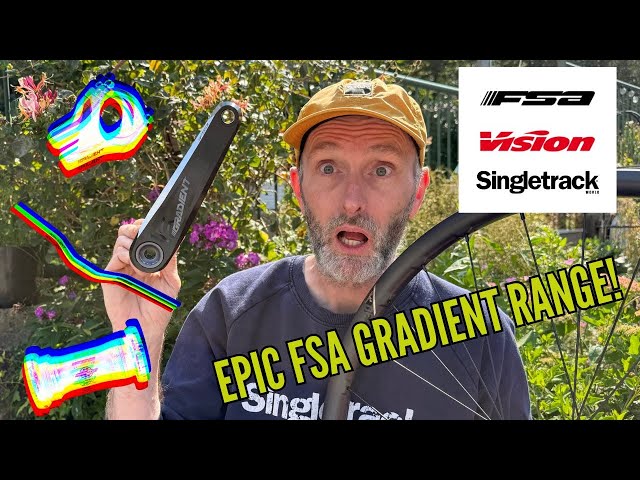
Why FSA's all-new Gradient range should be on your shopping list.
The FSA Gradient range is designed as a cohesive component system for the sort of trail and enduro bikes we ride week-in week-out. Wide bars, short stems, purposeful rise options, and durable finishing kit built to handle real-world riding rather than being a pure weight-weenie shootout.
Pair that with the Gradient i30 Carbon wheels and you’ve got a practical, hard-wearing setup aimed at riders who want confident handling, fewer creaks, and less maintenance faff in between rides and races.
In this video Tech Ed Benji runs through the key products, what they do, and - more importantly - what they're designed to feel like on the trail.
.
Read more: https://singletrackworld.com/2025/12/why-fsas-all-new-gradient-range-should-be-on-your-shopping-list/
Show More Show Less View Video Transcript
0:00
Hello, my name is Benji from Single
0:02
Track Magazine and I'm here to give you
0:03
the rundown on FSA's new gradient range.
0:14
FSA stands for full speed ahead and
0:18
they've been around for a long time.
0:20
1993,
0:22
which is almost as long as I've been
0:24
riding mountain bikes. They started with
0:27
bars and stems and then cranks came
0:31
along and then they were happy with the
0:32
XC world because that's all we really
0:34
had back in the 90s and early naughties
0:37
and then in 2010 they came out with the
0:39
gravity range
0:41
which is slightly tougher higher built
0:46
products bars stems. Then in 2013 they
0:49
came out with a subgraity range so not
0:52
downhill. This was the birth of Enduro
0:55
kind of world and they came out with the
0:57
original gradient range. The gradient
1:00
range was last refreshed in 2021
1:04
which is an eon ago in mountain bike by
1:07
industry terms. So the new stuff still
1:09
called gradient and it's model year 2026
1:12
and it encompasses everything from trail
1:15
enduro
1:17
all mountain who likes that I do. All
1:19
the way up to downhill as well. It's all
1:21
called gradient now.
1:23
Flagship item of the gradient range I30
1:27
carbon wheel set 30 mil internal
1:31
dimensions outer dimensions 37. Now
1:34
maths fans will realize that that means
1:37
each wall is 3.5 mil thick. That's
1:41
pretty flipping thick and that's stop
1:44
ward off kind of ripping your tires on
1:46
pinch flats because you can pinch a
1:48
tire. 28 spoke straight pull. And
1:51
although they're black and you go, "Oh
1:52
no, they're not aluminium, they're
1:54
brass." I can look down that hole there.
1:57
We'll do a closeup at some point. You
1:59
can see the brassness. They are
2:00
asymmetrical. So you can probably see
2:02
that the holes aren't quite in the
2:04
middle. And that's to offset on the
2:05
front for the disc location.
2:09
Let's get the rear, which is
2:11
conveniently here. Those are offset even
2:14
more cuz there's more to offset, isn't
2:16
there? There we go. Should we do a a
2:18
test? Yeah.
2:22
That to me sounds like a ratchet system
2:24
because it is. PRS 72 72 points of
2:29
engagement which is P O E for all you
2:33
acronym fans out there which is a nice
2:35
blend of being quick but not too quick.
2:38
The hub bodies are CNC machined,
2:40
lightweight, and don't require tools to
2:43
pull them apart. They also have a QR
2:46
code printed onto them. The specific QR
2:49
code when scanned by a smartphone will
2:51
take you to an online service manual and
2:54
spare parts list.
2:56
Oh yeah, the other thing that FSA have
2:58
done which doesn't matter but does is
3:00
done a rejig of the graphics. So the
3:03
gradient now has a little three stripes
3:06
in front of the G like FSA always have
3:08
had in front of FSA logo. So just a
3:11
little bit of an echo there. In general,
3:13
FSA have done a very good job style-wise
3:16
of the new gradient range. I like the
3:17
look of them a lot.
3:20
Oh, just hang on. Weights because you
3:24
want to know weights, which you should
3:25
do because the only thing you should
3:26
bothered about with weight is your
3:27
wheels. These are 1889
3:30
and they actually are. That's not
3:32
including tape or valves. But you do get
3:35
tape
3:37
and you do get valves somewhere. two of
3:41
them, one for each wheel, with the super
3:43
cool clear valve caps, which means
3:45
everything.
3:47
Now, you'll notice they have
3:49
asymmetrical
3:51
rim beds like up and down. So, it's 22
3:53
mil deep there and 24 mil where the
3:56
spoke comes in, a turret, I think they
3:58
call them, which is quite pleasing.
4:00
There we go. Nothing weirdly proprietary
4:02
about that. Cartridge bearings, easy to
4:05
service.
4:07
Good. All the gradient wheels go through
4:10
quite a number of strength tests and
4:12
durability tests. They do one called the
4:15
torsion tests that applies torsion,
4:18
funnily enough, like pedal forces going
4:20
through. So they can measure it rather
4:21
than just spin a static wheel. You can
4:23
actually test it as if you're putting
4:24
load through it. And converse if you're
4:26
putting braking on it, because that's
4:27
torsion the other way. They whack it
4:31
with a 90 kg load over and over again.
4:34
See how it gets on and easily passes
4:36
that. I think it's 90 jewels and I think
4:38
the industry standards 40. So it's more
4:40
than double what a lot of other people
4:42
are putting their tests through. They
4:44
also apply 150 kg weight to the spokes
4:48
and the spoke bed hole as further tests
4:51
particularly to mimic kind of landing
4:53
side loadings and things like that. And
4:55
not just for us Brits because it does
4:57
rain in Italy and all kinds of places.
5:00
They put them through a mud test, which
5:02
is essentially just slathering it in
5:04
watery mud and spinning it round and
5:06
round and round and round and round. And
5:07
once they done all those tests, they do
5:09
them again. So, you can be rest assured
5:13
that you've got a pretty
5:15
reliable, durable, real world mountain
5:18
bike wheel set. Next item, the modular
5:23
crank, gradient crank. That's green,
5:26
isn't it? 30 mil spindle. And that's
5:28
something FSA arguably pioneered and did
5:31
first with a mega mega Evo BB and it's
5:34
been 30 mil spindle ever since. Now
5:38
these are hollow. I don't have the
5:41
hollow there. I mean the hollow inside
5:43
this bit. That's one piece. That's
5:44
another piece. And they're bonded
5:46
together by incredible superlue. and
5:50
that makes them quite a bit lighter than
5:52
ones that would have material in the
5:54
middle and stiff as old boots. Now, the
5:57
preload collar is nice. It's not a
5:59
plastic dinky one with a 2 mil nip up
6:01
screw. The preload collar is nice
6:03
aluminum with a decent 2 and 1/2 mil
6:07
nipp. Just keep them in check. Now, they
6:09
come in 165,
6:11
170, and 175. We've got them in 165,
6:14
which is the righteous length. Now, to
6:16
go with that, I don't want to touch this
6:18
because it's all greasy. It's a bottom
6:19
bracket. Now, bottom brackets aren't
6:21
massively interesting, are they? Apart
6:23
from when they're really getting on your
6:24
wick because it just keeps creaking and
6:27
you need another one. Now, 30 mil
6:29
spindle is bigger than a 24, isn't it?
6:32
Just about fits through a shell. So, the
6:35
you can tell that that has quite big
6:38
bearings. So, it's not 30 mil. And then
6:40
the outer diameter is just a usual
6:42
whatever it is on a 24 mil. Those are
6:44
big old cartridge bearings in there. And
6:46
you get that with it which is nice.
6:50
Nothing press fit. Didn't want didn't
6:52
drop it. Could do if you want. I'm going
6:55
to do out. Is it? And it will fit 68 and
6:58
73. Who has 68 bottom brackets anymore?
7:01
No one. This is probably the most
7:05
rejigged aesthetically
7:07
speaking product in the new FSA gradient
7:10
range. The new stem gone is the oil
7:12
slick one. We've left that behind. We've
7:14
done that. All power to you if you've
7:16
got that kind of thing. Now FSA
7:18
gradient. This is a 33 mil stem which is
7:21
a nice length. They also come in 40 and
7:25
50 and the tail lights slight rise to
7:28
it. It's a 60° rise. Zero gap design. 2D
7:32
forged and then CNC machined a lot. That
7:36
is quite a snazzy crisp little unit.
7:38
That what do you put inside a stem?
7:42
Handlebars. Classic FSA item we have
7:45
here alloy aluminum also available in
7:49
carbon and then 35 mil clamp and 318.
7:53
This is a 318 alloy bar. The alloys are
7:56
available in 25 mil rise and 40 which we
8:00
have here. The carbons are in 20 and 30
8:03
mil rise. They're all 800 mil wide and
8:07
they're all neutral. Eight degrees back,
8:10
four degrees up. Now FSA are quite
8:15
transparent in saying that carbon is not
8:18
necessarily better than alloy. They do
8:21
different things for different people.
8:23
So for example, this one is G.
8:25
Adverton's signature bar. He had a lot
8:28
of input into designing this because he
8:30
wants a bar that will bend a lot when
8:33
you're doing stupid things like jumping
8:34
off a cliff. Whereas carbon's more for
8:38
more groomed bike parky vibration
8:41
absorption stuff. So, aluminum for rough
8:44
riding and carbon for trail riding if
8:48
you want, but you know, metal is good.
8:51
Also on here, you got textured finish.
8:54
So, you got trim markings there and
8:55
you've got little markings here to help
8:57
you align your brakes and your shifters
8:58
in the same place, which is very good
9:01
for the nerdy amongst us. I like doing
9:04
that. And to further help with big wax
9:07
and a bit of bend, those bits are
9:08
slightly flattened there, which gives
9:10
them a little bit of that. It doesn't
9:12
affect any of that. Clever. I like that
9:15
a lot. Okay. If you want to know all the
9:17
weights and measures and all the
9:19
different options, go on singletrack
9:20
world.com and look for the feature on
9:21
FSA gradient that will be on about now.
9:25
All these things we're going to stick on
9:27
a mountain bike and rag it around for as
9:29
long a time as possible and see how it
9:31
all gets on. Each part will be
9:33
individually tested. So, in a few
9:35
months, click on and have a look what
9:37
the review says about each item. That's
9:40
it from me. I'll see you next time. Bye.
9:45
Have I got like a black, you know, like
9:47
police academy? Was it where he put an
9:49
ink on his
#Sports