Up next in 10



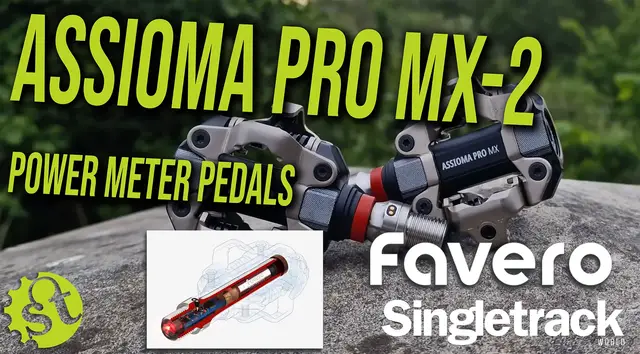
We got our hands on a set of the new Assioma MX-2 power meter pedals to see if we could use the data to improve our riding. Here Hannah runs you through the key details of these astonishingly clever clipless pedals. If you thought power meters were just for pro racers then think again. Hannah explans how this super compact tech can benefit any mountain bikers looking to improve their technique and fitness, be that for racing or just to enhance your riding fun.
Check out the complete Favero Assioma MX range of pedals and accessories at https://bit.ly/40OOuN1
Coming soon: A full feature on these pedals after we put them to the test.
Show More Show Less View Video Transcript
0:00
Hi, I'm Hannah from Single Track World
0:02
and I'm here to tell you about the Favo
0:04
Aoma Pro MX range of power meter pedals.
0:15
The Favo Aioma Pro MX pedals are Favo's
0:19
off-road pedals equipped with power
0:21
meter sensors. MX is the bit of the name
0:24
that tells you that they're for
0:25
off-road. XC mountain biking, cycle
0:28
cross, uh, and gravel. The probe bit
0:31
tells you that they're from the latest
0:33
design, but more on what's special about
0:35
that in a minute. What we have here are
0:38
the Aoma Pro MX2.
0:41
These have a power meter sensor in both
0:45
pedals and a £599
0:48
in the UK.
0:51
There's also a Pro MX1. Uh they only
0:55
have a power meter sensor in the left
0:57
side pedal. They're £399 in the UK. And
1:01
if you do go for the MX1 and then you
1:04
decide you want to upgrade to the MX2,
1:06
there's an MX up upgrade package.
1:10
Power meter pedals can help your riding
1:11
in a variety of ways. Perhaps you want
1:14
to see the gains your training is
1:16
making. Combining a power meter
1:18
alongside your heart rate monitor gives
1:20
you uh much more accurate data on your
1:23
outputs. Or if you're racing and you're
1:26
trying to measure your effort, these
1:28
pedals could also help you. If you can
1:31
see yourself hitting a sustainable
1:33
number, then it can help your head tell
1:36
your legs that it's okay. You're going
1:37
to get through it. You can keep it up.
1:39
Uh even when your legs are trying to
1:41
tell your head something different.
1:44
Maybe you're trying to improve your
1:46
technique. Power meter pedals,
1:48
especially a pair of them, like we have
1:51
here on the Aoma Pro MX2, can help you
1:54
analyze the efficiency of your legs as
1:57
you work through the pedal stroke. It
1:59
can allow you to experiment with bike
2:01
fit. Um, and you can figure out where
2:03
your most powerful position is. Or you
2:06
could use the data to identify
2:08
weaknesses in the stroke point and
2:10
perhaps do some gym work to even it up,
2:12
which could be handy for injury
2:14
recovery.
2:17
FA's aoma pedals use a couple bits of
2:19
technology to help make this analysis
2:22
more accurate and effective. The IAV
2:26
power system, which is the instant
2:28
angular velocitybased power calculation,
2:31
uses an integrated gyroscope to measure
2:35
real variations in power through the
2:37
stroke. This is especially important
2:39
with oval chain rings where estimates of
2:42
power based on a perfect smooth circle
2:46
uh will be inaccurate.
2:48
These pedals have in-built sensors which
2:51
monitor your position on the pedals, uh,
2:54
allowing you to analyze things like how
2:56
much time you spend out of the saddle.
3:00
If you've ever wondered if it's more
3:01
effective for you to sit and spin your
3:03
way up a hill or to stand up and push
3:06
hard, these pedals will help you figure
3:08
out what works for you.
3:12
Perhaps one option gets you to the top
3:13
quicker but leaves your legs in meltdown
3:16
for the flatter section after it.
3:18
Figuring this out could help your race
3:20
strategy.
3:22
Favvero's pedals also detect the power
3:25
phase which tells you the point of the
3:27
stroke with the highest power output.
3:30
And in the off-road MX model like these,
3:34
you get the platform center offset or
3:38
PCO sensor, which tells you how force is
3:41
distributed across your pedal during the
3:43
stroke.
3:46
So, lots of reasons why you might want
3:49
these power meter pedals on then to the
3:52
pro part of the pedal name. Obviously
3:56
you have the pedal platform which in
3:58
this case is a Shimano cleat compatible
4:01
structure and spare parts are available.
4:04
You can see the charging ports here
4:06
which connect to a power source via the
4:09
USB compatible connector.
4:15
The power meter element comes down to
4:18
three key parts. The electronic
4:20
components, the strain gauges and the
4:22
battery. How you put those elements
4:25
together within the pedal will affect
4:26
the durability and maintenance options
4:28
of a pedal. We've all had the fun of
4:31
servicing pedals. Now, imagine adding
4:33
some electronics into the mix. While
4:36
some power pedals have batteries or
4:38
sensors outside the spindle or the pedal
4:40
body, with the Favo Pro range, all the
4:44
sensors, electronics, and batteries are
4:46
tucked away inside the spindle. that
4:49
keeps them as safe as possible while
4:51
you're out on the trail, but should see
4:53
your wallet feel the benefit. All those
4:56
electronic bits are tucked away from
4:58
your clumsy fingers.
5:00
Tucking it all neatly inside the spindle
5:02
and having the gauges, battery, and
5:04
connecting components together, all
5:07
neatly side by side, should give you a
5:10
nice consistent reading with no dropouts
5:12
where connections between separate
5:14
components get lost. It's a rechargeable
5:17
battery that's in there, too. At 60
5:19
hours, it won't last quite as long as a
5:21
typical watch or coin type battery, but
5:26
charging them is simple and you'll save
5:29
the fiddling of having to fit new
5:31
batteries.
5:33
All the measurements in the world are no
5:35
good, however, if they don't feel right
5:37
as pedals. And Fava has worked to make
5:39
these a truly top functioning set of
5:42
pedals.
5:44
The stack height, which is the distance
5:46
between the center of the pedal spindle
5:48
and the surface where the cleat rests on
5:51
the pedal, is a relatively low 11.2 mm,
5:55
meaning you'll not feel like you're
5:57
pedaling in platform shoes. Favvera
6:00
claims the Aoma Pro MX is the lightest
6:03
mountain bike pedal-based power meter
6:05
around at only 194 g per pedal,
6:10
including the battery. However, they're
6:12
also designed to be durable. They've
6:14
built the pedals using 6061T6
6:17
aluminium and no plastic parts. Plus,
6:21
things like the end cap doesn't stick
6:23
out, which would risk damage if you hit
6:26
the pedal on the ground.
6:28
Each pedal uses two needle roller
6:31
bearings, which will withstand a dynamic
6:34
load of 300 kilos per roller, which
6:37
should be more than enough for even a
6:39
track rider to get out and enjoy the
6:41
trails. If these pedals sound like they
6:45
might add to your off-road rides, head
6:47
to cycling.
6:49
com to audios and find out more.
6:55
[Music]
#Sports
#Cycling