Thinking of getting some SPD-SLs (or equivalent Look, time etc.) for the road bike. Have used Time ATAC carbons on there up to now with my MTB shoes, but am hoping to do some longer rides this year and wondered if having "proper" road pedals would be worthwhile with the larger platform possibly being more comfortable for long rides. Also, I wouldn't need to de-clag my MTB shoes before going for a road ride. 😉
However, I do understand that road pedals make you walk funny and have heard that they may be harder to clip in/out of than MTB clipless pedals, also that they have less float than MTB pedals? I need to have the same float as the ATACs at least to cope with my dodgy knees.
Any thoughts/recommendations?
Definitely more efficient due to larger platform, but take a while to get used to and difficult to walk in
Definately less float but no difference to clipping in and out. I've stated my opinion on road pedals before on here, I don't think any of them are as good as SPD's Get some shoes with stiffer soles and the platform issue is resolved.
And yes, once you're off the bike in road cleats, you end up walking around like you've soiled your shorts.
not in my opinion
The main fifference you will notice is in the shoes. Good road shoes are designed not to flex at all. Even the stiffest MTB shoes are designed with some flex so that you can walk in them. That will make a huge difference to how well you can transfer the power.
Buy the stiffest shoes that you can. To some extent this eliminates the need for a large pedal platform, as it eliminates any dead spot/numbness inducing pain from the pedal under your foot. Look at the Speedplay pedals that are so popular for example. I wouldn't personally consider buying them, but I only mention them as an example of a particularly small pedals that would be impossibly uncomfortable if you didn't have stiff shoes.
Having said that, a larger pedalling platform does have its advantages. You can't go wrong with Look or Time if you want float for your knees, but even the latest Shimano road pedals have quite a decent platform.
Don't worry about walking. As I said, you aren't really meant to walk any great distances in road shoes anyway, but most modern cleats have some sort of softer rubber 'outriggers' that are more grippy than the slippery cleat, and spaced wider so you aren't balancing on a small cleat.
And don't worry about clipping in and out of single sided pedals. The pedals are weighted so that as you turn the cranks, they 'present themselves' cleat up. You won't need to look down after a short while.
If you are serious about enjoying riding the road bike, definitely take the plunge. You'll realise how inefficient your mtb shoes and pedals really are for pedalling. They are inevitably designed as more of a compromise between a number of requirements (including walking), whereas the road shoes and pedals are designed with one purpose in mind. It's the old question of horses for courses. Road pedals and shoes for the road, mtb pedals and shoes off road.
The best advice would be to spend a bit less perhaps on the pedals and shoes, and spend a bit more on some footbeds. These make more difference than saving a few grammes on a pedal upgrade, or a flashier shoe.
And, resist the temptation to over-tighten your shoes. You would be surprised how much your feet heat up and swell. If your shoes are too tight, this can cause discomfort, and people often mistake this for issues with the stiffness of the shoes sole. When you first set out in the morning, you need your shoes much tighter than you will later on in the ride. Watch the pros. You will often see them tightening up their shoes towards a sprint finish. This absolutely helps with power transfer, but would be uncomfortable for the 200+ kms that they have ridden prior. You don't want your heal slipping out, but resist the temptation (which is easy to do with all the ratchest and gadgets that modern shoes have!) to over-tighten.
And don't worry about clipping in and out. The pedals are weighted so that as you turn the cranks, they 'present themselves' cleat up. You won't need to lok down after a short while.
Is that right?
I have some Looks in the workshop but got peed off with them being constantly 'upside down' just as I was trying to quickly clip in at junctions etc.
up there with leg shaving, do it if you want to but don't kid yourself that it really makes any difference as a recreational cyclist
Road pedals are no harder to get in and out of then MTB pedals. They are one sided but they self position to the correct way round. And you rarely clip out on the road anyway.
Maybe the bearings aren't as free moving as they should be? Most road pedals definitely flip 'right way up' at the appropriate moment to clip in.
Are they modern or older Looks? Keos certainly do this.
Nick. It makes a massive difference.
Thanks for the replies. OK, so at the moment (if I'm reading people's opinions right!) it's neck and neck between SPDs and SPD-SLs, with 3 votes each plus one undecided/recommending leg shaving. 😉 Anyone want to tip the vote one way or the other?
was about to advertise some look keo carbons in the classifides. brand new. cheap. drop me an email on mtb_crasher (at) hotmail.com
ive got spd sls on my road bike drive me nuts! my road shoes are super stiff but im struggling to enjoy using these one side road pedals.
maybe thats just being used to spds for 15 years though!
Interesting article here
http://www.bikejames.com/cardio-training/barefoot-pedaling-do-clipless-increase-overuse-injuries/
Perhaps you should try some 5:10s and Canfield Crampons 🙂
Road bikes tend to have a lower bottom bracket so road pedals give better ground clearance. Reduced chance of catching underside of pedal on tarmac (on roundabouts etc).
I'd argue the point about road pedals presenting themselves the right way. I have looks and SPD-SL pedals and neither of them do this.
Feels far nicer with a decent set of road shoe and pedals. Especially in the winter months when the MTB shoes are still caked in mud
A second pair of MTB shoes just for road use, maybe?
Macavity - Member
A second pair of MTB shoes just for road use, maybe?
Yeah, I had considered that as an alternative. Keep the views coming, it's interesting reading. I don't think i'll be buying the 5.10s though. 🙂
Having used S-Works MTB shoes (amongst the stiffest out there) on the road bike on occasion it's no contest for me, road shoes/pedals feel better and are vastly more comfortable. Can't specifically comment on increased power output, but the comfort is undeniable, and that matters when you're sitting in the same position for hours on end!
This road pedal malarky looks impressively complicated:
http://www.lookcycle.com/keofit/
http://bikefitkit.com/dealer/index.php?osCsid=89ca26d9fa7b9e76f335b349d35394e4&
If you are buying a second pair of shoes why not just buy a road shoe instead of MTB?
i find they present themselves correctly on the up stroke and onto a bit above the crank in the horizontal rearward facing position... at top centre, the pedal is in the wrong orientation, but then I don't clip in there - i'm scooping the pedal up as it comes up to my foot, so it works perfectly.
I've only had a couple of rides on them, but they work really well. I've got some shimano R160 shoes in one of the silly cheap sales around atm, and wow! what a difference to high end spesh mtb shoes and shimano mtb pedals. Really stiff shoes, and a MUCH bigger platform I can notice - much more stable and much less rocking in the pedal.
loving the feedback and response from them compared to mtb shoes and pedals on the same bike.
There's some really great advice here (particularly about the cornering angle), and lots of alternatives, but getting back to your original post, you said you were about to buy some road pedals and shoes and you wanted some advice.
The simple advice is just go and get some!
Your fears about being difficult to walk in, difficult to clip into etc are not a problem in reality and they'll make a big difference. You won't know just how big a difference until you try, but I guess that's why you asked for advice from people who have?
Definitely avoid a 2nd pair of MTB shoes. Other than being cleaner than your muddy ones, where's the benefit? And don't get hung up on the single sided thing. There are literally millions of people around the world using single sided road clipless pedals. As one of them, I can assure you that in reality it simply isn't an issue. You clip in and out much less than you do off road anyway, but even when you do clip in, it really isn't that hard at all.
Spend as much as you can on shoes, and don't worry so much about the pedals. Bearing life is much less of an issue than on an MTB, and the comfort you'll get from better, stiffer shoes is worth more to your enjoyment.
Covering your other issue of float. You move about on the bike much less on a road bike, so this in itself should put less lateral rotational force on your knees. Look and Time in particular have some degree of float, but the point of road bikes in general and the fit in particular is to be comfortable and efficient in a relatively fixed position vs a mountain bike. You spend longer in one position pedalling than you do on a mountain bike where you are moving around a lot more. That's not to say that you shouldn't consider float, but more that it less of an issue. Properly fitting shoes with custom insoles (which are transferable between your shoes) and possibly come correctional wedges to straighten your pedal stroke will do you a world of good in combatting knee problems anyway.
The 'problem' with road riding (if you can call it that) is that the constant fixed position and pedalling accentuates problems with bike fit and technique more than a mountain bike where you are not in any one position for long. If you chose to take your road riding a bit more seriously (which it sounds like you are about to), a proper bike fit including setting up your pedals might be well advised. This £100 (ish) would make far more difference to your technique, comfort and ability on the road than any £100 spent on equipment.
Are these road pedals to put on your mountainbike?
I just don't think there can be any arguement against have dedicated road pedals on a road bike.
However if it's for the MTB I think stiff MTB shoes would do the trick. Shimano give a stiffness rating. I think for MTB shoes it's about 3 to 9 out of 12, and up to 12/12 for road shoes.
Thinking of getting some SPD-SLs (or equivalent Look, time etc.) [b][u]for the road bike[/b][/u]
As Roy Walker used to say, the clue's in the question. They are for the road bike. In which case, I agree it's a complete no brainer.
Anything else is just a compromise.
Mister P - Member
If you are buying a second pair of shoes why not just buy a road shoe instead of MTB?
That's what I was thinking of doing, as sola said I was just asking for opinions on whether it made enough of a difference to be worth it over just continuing to use my ATACs.
oldgit - Member
Are these road pedals to put on your mountainbike?
No, road pedals for road bike.
Thanks for all the advice. Will have a serious look at some road shoes and SPD-SLs or the Time/Look alternatives as it sounds on balance like they are probably worth it!
I really can't understand what people are on about with talk of comfort.
I mean, you are riding a bike not walking!
I don't think I've ever had uncomfortable feet on a bike (apart from them being a bit cold occasionally), even when riding for 10+ hours.
You might have a problem finding a decent road shoe that take the SPD cleats. Most are now only drilled for what has become the standard 3 bolt road cleat pattern. There must be some out there though.
Glen. As I said, comfort is more of a concern on a road bike as your are in a fixed position for longer, and generally pedalling more of the time than you are off road. There is much less rest available for your feet.
BTW, pretty impressive stuff cycling non stop for 10 hours!
😳 I clearly read that in typical STW fashion.
I have a pair of stiff-soled Spesh MTB SPD shoes; they are basically identical to the road versions, but with a bit of grip on the sole. I use them with a pair of these on my road bike:
[img]  [/img]
Shimano A520. Nice light pedals. Maybe not as 'high performance' as road shoes and cleats, but they do the job for me. I'm not into racing. A good compromise, I feel.
The 'problem' with road riding (if you can call it that) is that the constant fixed position and pedalling accentuates problems with bike fit and technique more than a mountain bike where you are not in any one position for long. If you chose to take your road riding a bit more seriously (which it sounds like you are about to), a proper bike fit including setting up your pedals might be well advised. This £100 (ish) would make far more difference to your technique, comfort and ability on the road than any £100 spent on equipment.
i'll second this advice. a switch to road shoes/pedals accentuated a knee mistracking problem. sorted with a proper fit and a pair of specialized footbeds and wedges.
solarider - Member
You might have a problem finding a decent road shoe that take the SPD cleats. Most are now only drilled for what has become the standard 3 bolt road cleat pattern. There must be some out there though.
The SPD-SLs are the 3 bolt pattern AFAIK so it shouldn't be a problem. There is a shop near us that does fitting sessions, so I might look into that as well. Thanks to all for the advice.
Al. My comment was in reference to you possibly wanting to use road shoes with your SPDs.
SPD - Shimano's Off Road, double sided pedal (uses the 2 cleat bolt attachment).
SPD SL - Shimano's Road single sided pedal (uses the standard 3 bolt road pattern)
If you are going the whole hog with shoes and pedals you'll be fine. It's just that not many road shoes have the SPD 2 bolt drilling.
Ok, got it now. I think a couple of the low-end Specialized road shoes are drilled for both, but as you say I'd go the whole hog if I'm going to bother at all. Do you have any recommendation as to pedal brand (Shimano vs. Look vs. Time)? They all look pretty much the same to me. 🙂
And you are right to think that they all look pretty much the same. There is much less to a road pedal. There isn't much to chose between them in terms of bearing quality, and mud clogging isn't an issue, so that doesn't really matter. In the end, I would go for whatever you can get the best deal on. As I said, spend on the shoes, not on the pedals. Get the cheapest pedals you can from one of the big brands.
I have always ridden Time, but that goes back to the days when Time offered some float adjustment and Look didn't, and Shimano were running tiny metal cleats (like off road cleats) that caused a hotspot under the foot as shoes weren't as advanced as they are now. Nowadays there isn't much to chose as most of them share similar features.
Walking seems to be a concern and in this respect, I would go for Time as they have what's known as a 'cafe cleat', with rubber outriggers that help you to walk but aren't part of the cleat itself, so you aren't wearing out the bit that clips into the pedal. You actually walk on the part of the cleat that you clip into the pedal with Look, but the KEO system has always received great reviews.
If you look at the Pro Peleton, pedals and shoes are often the few items that riders don't have to use because of team sponsorship deals. There seems to be a preference for Look, followed by Time, followed by Shimano, with a few using Speedplay, but that is mainly down to team sponsorhip deals.
Have a look on Ribble and go from there for pedals, but buy your shoes from a bricks and mortar shop. The fit is everything.
Actually not too worried about walking, that was more in jest. 🙂 Float/adjustability/ease of use are really the main things I was concerned with, sounds like they are all pretty much the same in use/adjustment so I might go Look simply because they seem to have the most float (although I take your point about it not being so important on the road). Will have a browse at a few different models online, thanks.
the bit you walk on is obviously the other side to the bit that retains your foot when you ride. i have just picked up some keo's for myself and a set of mid range shimanos (70 IIRC on CRC - 2 many TLA's)
incidently the shoes have drillings for both look style cleats and spd style (mtb) cleats.
I would also agree that road pedals are good, but mainly because you get to use road shoes which are WAY better than mtb shoes on the road. Better support in the upper as well as far better support of the sole.
Only disadvantage is that if you have to walk any kind of distance you can wear the cleats out quite quickly - even if it's a long walk from the carpark at work to your desk, for instance - if you do it daily.
there is no need to wear out your cleats if you plan ahead.
http://www.bicyclebuys.com/item/0486675/UK
The covers are ace, Keos and Little Chef floors don't mix 😐
I just take my shoes off
I did the shoe taking off thing too. Got lots of funny looks tho - but then, I got funny looks all the time anyway at that place.
Has anyone mentioned Speedplays, which are said to be very good?
Also, the Mavic road pedals are said to be good too.
Having said all this, my road bike has Time ATAC XS Carbons on it...
Andy
very subtle cleat on them ones! ha ha ha
[img] 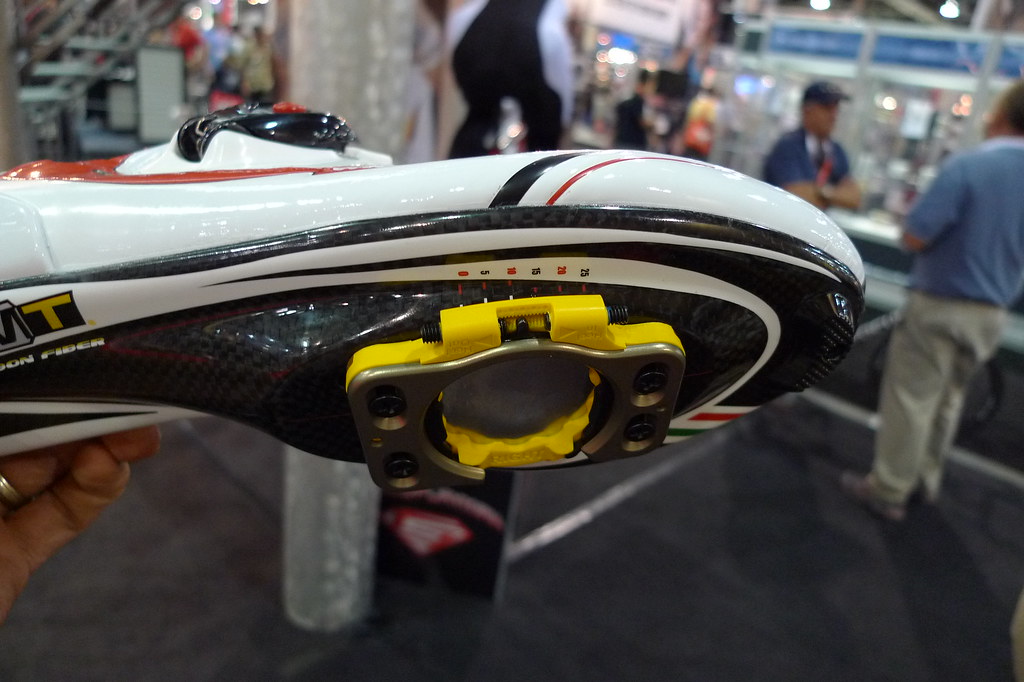 [/img]