- This topic has 55 replies, 14 voices, and was last updated 12 years ago by matt_outandabout.
-
Not very grand designs – need sound/heat insulation help
-
ourmaninthenorthFull MemberPosted 12 years ago
@wwaswas – it’s already painted. It’s also in good nick, so isn’t going to be touched (been inspected by a pro).
@mk1fan/don simon – fair enough, so the insulation would be less effective. Any idea what the percentages are?
@wrightyson – I’ll do a better drawing in a bit.
ourmaninthenorthFull MemberPosted 12 years agoOK – new drawings.
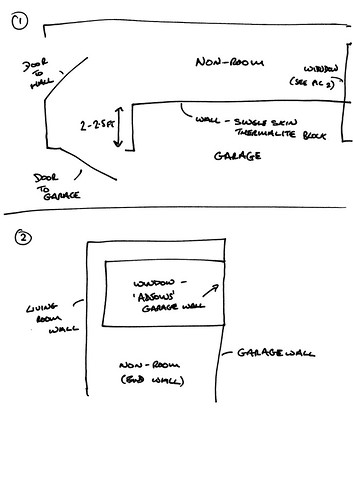
First is a plan view of non-room, showing reveal for garage door.
Second is end on view (elevation?) of non-room end wall with window. The window reveal is straight up to wall adjoining garage. the garage window on the other side of the wall is effectively a continuation of the window. Yes, it is odd, but this is a one-off house designed by the bloke who built it.
What that means is that any insulation on the non-room side of the garage wall would effectively overlap the window frame on that side, and may overlap the glass itself.
Have I made any sense?!!
 ourmaninthenorthFull MemberPosted 12 years ago
You’re over thinking the situation.
Probably. Feels like neither option is ideal. Just trying to work out which is better for the circs of the house.
Cheers
donsimonFree MemberPosted 12 years agoHave I missed something here or is there a valid reason for no mention of cavity wall insulation?
ourmaninthenorthFull MemberPosted 12 years agoHave I missed something here or is there a valid reason for no mention of cavity wall insulation?
I’m not convinced there’s a cavity – unless I’m much mistaken, it’s a single skin block wall.
donsimonFree MemberPosted 12 years agoI’m not convinced there’s a cavity – unless I’m much mistaken, it’s a single skin block wall.
How will that be affected by the change of use with regard to building regs and planning permission?
ourmaninthenorthFull MemberPosted 12 years agoHow will that affect the change of use with regard to building regs and planning permission?
Dunno. Not sought BR consent yet to knock thru.
wrightysonFree MemberPosted 12 years agoI can now see your plight! Have you thought about becoming an architect btw? 😆
So you’re only real option is to insulate the garage side then. Just as a note is the non room wall currently plastered??ourmaninthenorthFull MemberPosted 12 years agoFair to say I have stretched my artistic skills quite a way to draw these out, so no architectural retraining for me….
Non-room is a real room – used to be a bedroom before previous owners (not the original builders of the house) put the door into the garage. It’s just chillier in there than the living room, and gets noise – admittedly not a lot – via the garage and side window from the lane out the front of the house.
Actually, this week we had more noise out the back of the house as the farmers were ploughing the field in the dark. Lights on the John Deeres make troute’s efforts look a bit wimpy..!
OK, so we seem to be veering to insulating (as best as I can given the confines of the garage ceiling) the garage side of the wall.
Cheers all..!
MrSparkleFull MemberPosted 12 years agoShowed this thread to one of the technical guys from SRS and he says it’s important to not confuse acoustic insulation with thermal insulation. This is his post; Something that will stop sound will be very heavy, and isolated from the wall behind. How about battening out the wall with 2” battens and fitting kingspan or celotex thermal insulation between the battens. After that use resilient bars to isolate the new dry-lining from the wall behind, and then use two layers of heavy plasterboard or something a bit esoteric like Maxiboard (http://www.youtube.com/watch?v=-sPbPjKW8LM) to create the skin. You can put some mineral wool between the res bars too, it helps marginally but don’t lose any sleep about it if it gets forgotten and don’t pack it in too tight.
Cavity insulation, magic mineral wool, nanovacuums, eggboxes, polystyrene do f*** all!
Oh, and for the windows, secondary glazing that’s at least 2” from the existing glass and ideally a different thickness is the way to make windows better.
ourmaninthenorthFull MemberPosted 12 years agoCheers Mr Sparkle – that looks proper techy. Will have to read several times over later..!
mk1fanFree MemberPosted 12 years agoI did have a niggling feeling that the window was in an ‘odd’ position.
Celotex (or similar) glued and screwed to the garage side of the wall can be carried up to and abutting the ceiling without interfering with it.
You may also consider using a thermal wallpaper – such as Wallrock – on the warm side. A similar product is called Sempatap but it is a lot thicker (10mm as opposed to 3mm Wallrock) so may not work well with the window reveal.
For sound insulation construct a timber stud wall in the garage (20mm away from the wall) with mineral wool insulation and two layers of 15mm plasterboard. You can tie the head plate back to the wall rather than to the ceiling.
If you tape over the Celotex joints with the ali tape then you won’t need to worry about water vapour/condensation.
donsimonFree MemberPosted 12 years agoStill trying to head my head around 90% insulation will produce a cold bridge question. If there isn’t a cold bridge before insulating and no evidence of condensation, why is cold bridging suddenly going to appear when insulation is applied to some but not all the surface? And why isn’t it a problem with windows?
I can understand the idea of cold bridging through a solid medium like brick ties or a metal window frame, I just don’t understand how the characteristics of the wall can change…
matt_outandaboutFull MemberPosted 12 years agoIf the air can not circulate it will offer you good insulation, I think this is why they use it in double glazing.
hahahahaha etc. Which bit of the double glazing has a draft of air? It is a SEALED unit.
donsimon – all things relative, the whole darn wall is a ‘cold bridge’ at present, and all the wall is cool, so evens out areas of condensation. Make most of the wall newly insulated, and the temperature of that area of wall compared to the uninsulated bit means you will get more condensation on the cold/uninsulated bit. Like you do round most windows. In a perfect world you would avoid this, but it is not a deal breaker / mahooosive issue unless you are heading towards seriously low energy build…

The topic ‘Not very grand designs – need sound/heat insulation help’ is closed to new replies.
